
Organizations investing in workplace wellbeing training recognize that employee mental health directly impacts productivity, retention, and organizational resilience. Effective training goes beyond awareness campaigns to build competencies that transform workplace culture. As psychological safety and mental health literacy become business imperatives, structured training programs provide managers and employees with practical frameworks for recognizing distress, initiating supportive conversations, and implementing evidence-informed interventions. Understanding the components, delivery methods, and measurable outcomes of workplace wellbeing training enables HR professionals and leaders to make informed decisions that protect both people and performance.
Understanding Workplace Wellbeing Training Frameworks
Workplace wellbeing training encompasses structured educational interventions designed to enhance knowledge, skills, and organizational practices related to mental health. These programs differ from generic wellness initiatives by focusing specifically on psychological safety, stress management, and early intervention capabilities.
The NICE guidelines on mental wellbeing at work emphasize that effective training must address individual competencies alongside systemic factors. This dual approach recognizes that isolated skills development without corresponding organizational support yields limited results.
Core Components of Comprehensive Programs
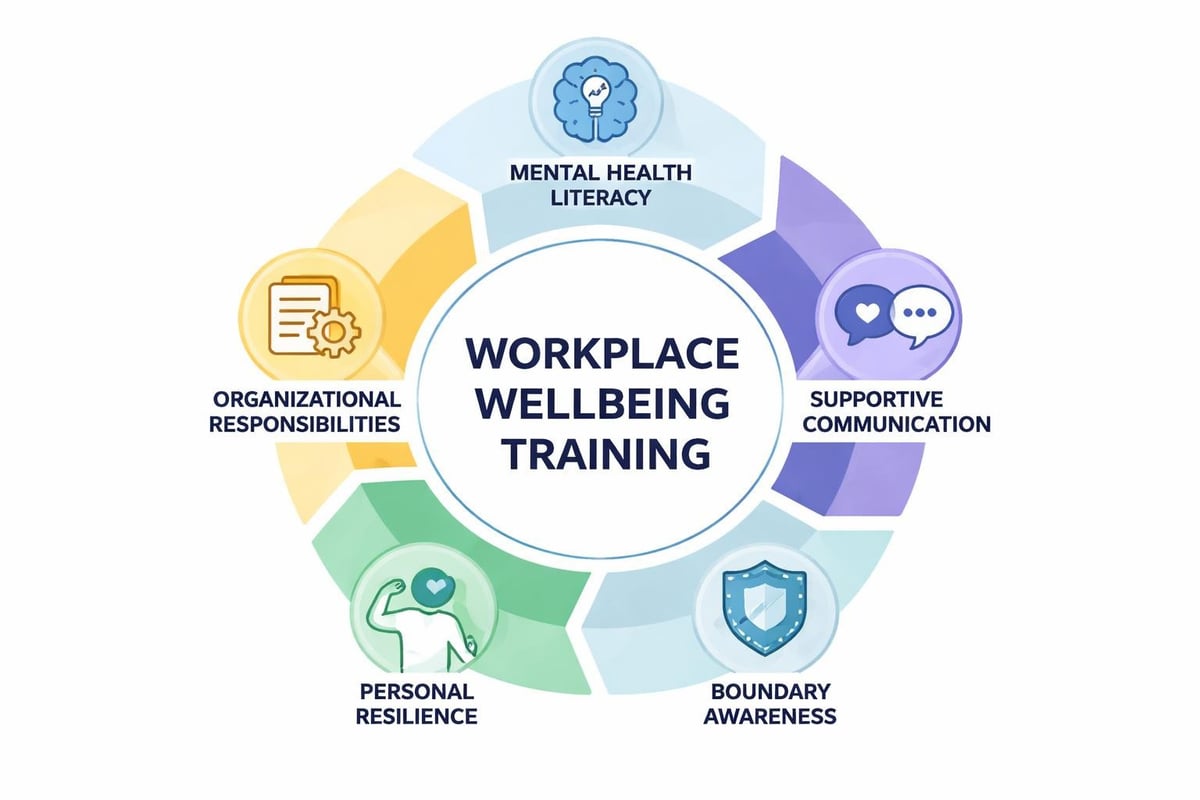
Effective workplace wellbeing training typically includes multiple interconnected elements:
- Mental health literacy: Understanding common conditions, recognizing warning signs, and challenging stigma
- Communication skills: Conducting supportive conversations, active listening, and appropriate questioning techniques
- Boundaries and referral pathways: Knowing professional limitations and connecting employees with appropriate resources
- Self-care strategies: Building personal resilience and maintaining professional wellbeing
- Legal and ethical frameworks: Understanding duty of care, privacy obligations, and workplace responsibilities
Organizations benefit most when training extends beyond managers to include peer supporters, HR professionals, and gradually the entire workforce. This creates a shared language and distributed responsibility for wellbeing.
Manager-Focused Training for Frontline Leadership
Managers represent the critical interface between organizational policy and employee experience. Their daily interactions shape workplace culture more than any strategic document.
Research consistently demonstrates that manager behavior influences team psychological safety, burnout rates, and help-seeking behaviors. Yet most managers receive minimal preparation for these responsibilities. Workplace wellbeing training specifically designed for leaders addresses this gap.
Essential Manager Competencies
| Competency Area | Skills Developed | Organizational Impact |
|---|---|---|
| Early recognition | Identifying performance changes, withdrawal patterns, behavioral shifts | Earlier intervention, reduced severity |
| Supportive conversations | Non-judgmental inquiry, empathetic responses, collaborative problem-solving | Increased disclosure, strengthened trust |
| Reasonable adjustments | Flexible work arrangements, workload modification, phased returns | Reduced absenteeism, faster recovery |
| Team culture | Modeling vulnerability, normalizing support-seeking, addressing stigma | Enhanced psychological safety, team cohesion |
Training for managers should emphasize practical scenarios rather than theoretical concepts. Role-playing difficult conversations, analyzing case studies with nuanced considerations, and practicing referral language builds confidence and competence.
The Workplace Mental Health Institute provides specialized manager programs that balance psychological accuracy with practical application, ensuring leaders can translate knowledge into daily practice.
Trauma-Informed Leadership Approaches
Trauma-informed care principles increasingly inform workplace wellbeing training. Managers learn to recognize how past experiences shape current responses, avoid re-traumatization through insensitive practices, and create environments where safety and choice are prioritized.
This approach proves particularly valuable in high-stress industries, organizations undergoing change, or workplaces serving vulnerable populations. Trauma-informed managers demonstrate:
- Awareness of how organizational policies may trigger stress responses
- Commitment to predictability and transparency in communications
- Recognition that perceived control significantly influences wellbeing
- Understanding that resistance often reflects legitimate self-protection
Employee-Level Training and Peer Support Models
While manager training provides essential leadership capabilities, employee-level workplace wellbeing training creates a foundation of shared understanding. Universal training reduces stigma, normalizes mental health discussions, and distributes support responsibilities.
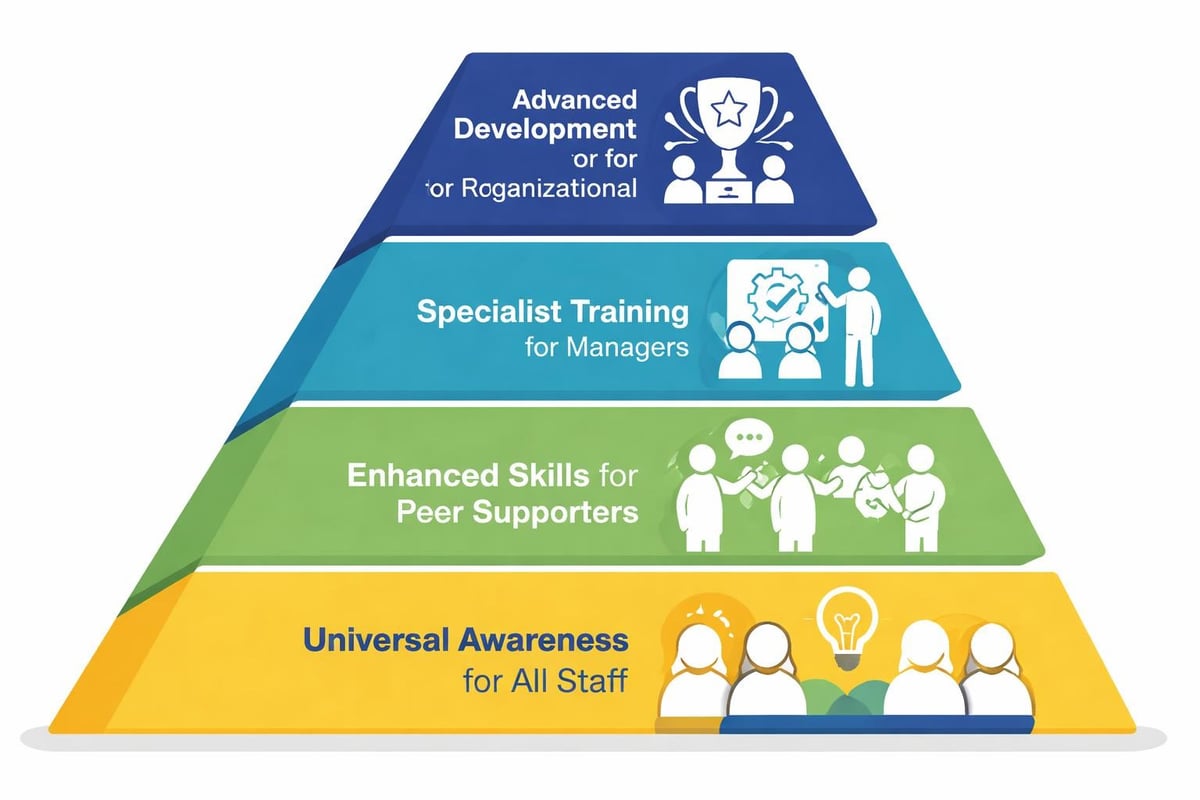
Organizations implementing comprehensive approaches often develop tiered training models:
- Universal awareness training for all employees (1-2 hours)
- Enhanced skills training for volunteers and peer supporters (4-8 hours)
- Specialist training for managers and HR (12-24 hours)
- Advanced practitioner development for internal champions (ongoing)
This structure ensures everyone possesses baseline literacy while developing specialized capabilities among those with direct support responsibilities.
Peer Support Program Foundations
Peer support programs train selected employees to provide informal, non-clinical support to colleagues. These programs prove particularly effective in organizations where hierarchical barriers inhibit manager disclosure.
Effective peer support training covers:
- Boundaries between peer support and clinical intervention: Understanding when conversations require professional referral
- Confidentiality parameters: Navigating privacy while ensuring safety
- Self-care and supervision: Protecting peer supporters from vicarious trauma
- Cultural competence: Recognizing how identity, background, and experience shape mental health needs
Organizations implementing peer support should provide ongoing supervision, clear protocols, and recognition that this represents additional responsibility requiring protected time.
Evidence-Based Content and Pedagogical Approaches
The quality of workplace wellbeing training depends heavily on content accuracy and delivery methodology. Programs grounded in psychological evidence demonstrate superior outcomes compared to generic approaches.
Psychological Accuracy and Current Research
Training content should reflect current diagnostic frameworks, evidence-based interventions, and nuanced understanding of mental health. Oversimplified explanations, outdated terminology, or misleading generalizations undermine credibility and potentially cause harm.
For example, effective training distinguishes between:
- Stress responses (normal reactions to demands) and clinical anxiety disorders
- Temporary low mood and diagnosable depression
- Workplace factors contributing to distress and individual vulnerabilities
- Supportive accommodations and enabling dependency
This precision enables participants to respond appropriately rather than over-pathologizing normal stress or minimizing serious concerns.
The Global Wellness Institute highlights how many organizations focus training on individual resilience while overlooking systemic factors like workload design and role clarity. Comprehensive workplace wellbeing training addresses both dimensions.
Interactive and Skills-Based Learning Methods
Adults learn differently than students in academic settings. Workplace training requires active participation, immediate relevance, and opportunities for practice.
Effective delivery methods include:
| Method | Application | Learning Outcome |
|---|---|---|
| Case study analysis | Reviewing realistic scenarios with multiple considerations | Critical thinking, nuanced judgment |
| Role-play exercises | Practicing conversations with feedback | Confidence, skill refinement |
| Reflective practice | Examining personal responses and biases | Self-awareness, cultural competence |
| Action planning | Developing implementation strategies | Application, accountability |
Online training platforms offer convenience but should incorporate synchronous discussions, breakout activities, and facilitator interaction rather than passive content consumption. Explore evidence-based online programs that maintain engagement through interactive design.
Measuring Training Effectiveness and Organizational Impact
Workplace wellbeing training represents a significant investment. Demonstrating return requires measurement frameworks that extend beyond participant satisfaction.
Evaluation Frameworks
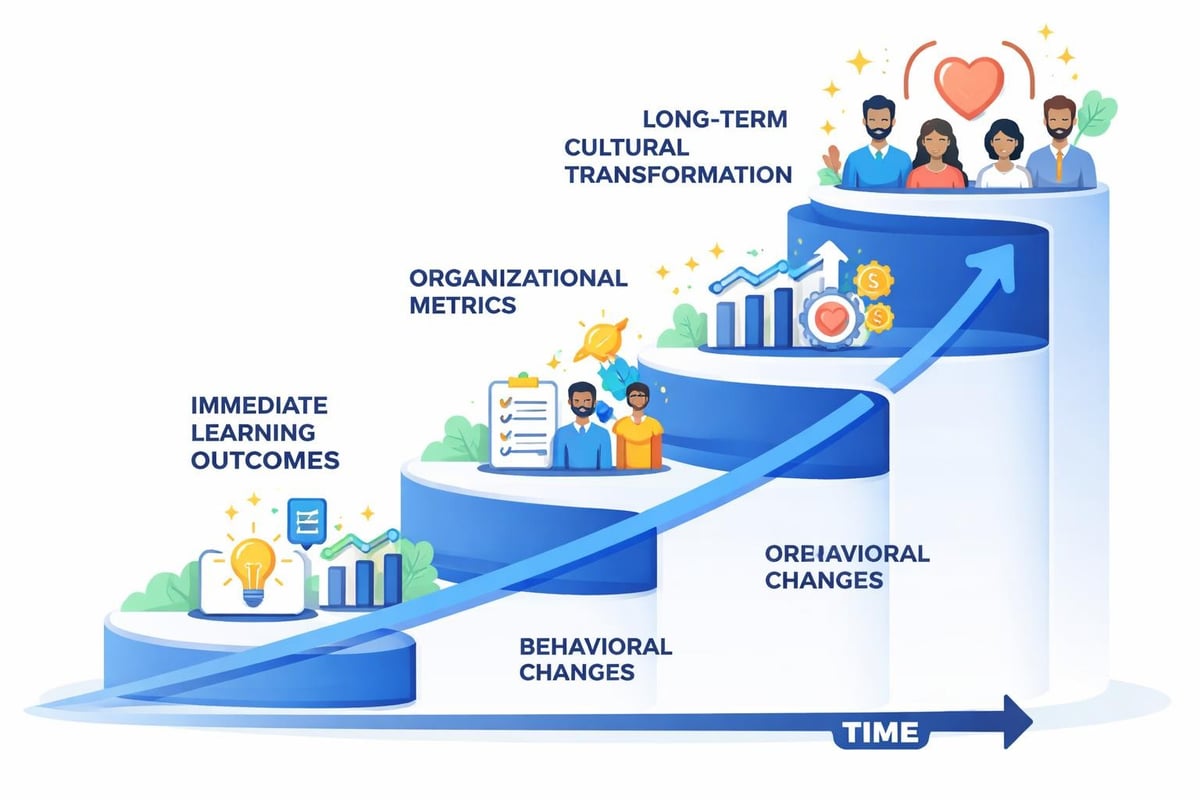
Comprehensive evaluation addresses multiple levels:
- Immediate learning: Knowledge acquisition and attitude shifts measured through pre/post assessments
- Behavioral application: Manager confidence in conversations, employee help-seeking rates, utilization of support resources
- Organizational metrics: Absenteeism trends, turnover rates, workers' compensation claims, engagement scores
- Cultural indicators: Psychological safety measures, stigma assessments, leadership trust scores
The CDC’s workplace health promotion training resources provide frameworks for program evaluation that integrate wellbeing outcomes with broader organizational health metrics.
Short-term measures should not overshadow longer-term culture change. Meaningful transformation typically requires 18-24 months of consistent reinforcement rather than one-time training events.
Common Implementation Challenges
Organizations frequently encounter obstacles when implementing workplace wellbeing training:
Insufficient leadership commitment: Training succeeds when senior leaders visibly participate, reference concepts in communications, and allocate resources for application.
Lack of systemic support: Skills learned in training lose relevance when organizational policies, workload expectations, or resource constraints prevent application.
Cultural resistance: Stigma, skepticism about mental health, or perceptions that wellbeing represents weakness require gradual, persistent address through multiple touchpoints.
Inadequate follow-up: Single training sessions without reinforcement, supervision, or advanced development produce temporary awareness without sustained capability.
Addressing these challenges requires treating workplace wellbeing training as an ongoing developmental process rather than a compliance exercise.
Specialized Training for High-Risk and Unique Contexts
Certain industries and circumstances require specialized workplace wellbeing training adaptations. Generic programs may fail to address context-specific stressors, regulatory requirements, or cultural considerations.
Industry-Specific Considerations
Healthcare settings: Training must address vicarious trauma, moral distress, patient aggression, and the unique challenges of caring professionals who may neglect self-care. Programs should integrate clinical knowledge participants already possess while building wellbeing-specific skills.
Emergency services: First responders benefit from training acknowledging operational stressors, cumulative trauma exposure, and organizational cultures that historically stigmatized mental health. Peer support models prove particularly effective in these contexts.
Education: Teachers and school staff require training addressing student mental health concerns, boundary management with vulnerable populations, and the emotional labor inherent in educational roles.
Corporate environments: Office-based workplaces benefit from training addressing performance pressure, organizational change, remote work challenges, and manager anxieties about productivity monitoring.
Organizations in Australia can access region-specific programs that incorporate local regulatory frameworks and cultural contexts.
Crisis Response and Trauma-Informed Training
Workplace wellbeing training increasingly includes crisis response protocols. Managers and HR professionals need frameworks for responding to:
- Mental health crises requiring emergency intervention
- Disclosures of suicidal ideation
- Trauma reactions following workplace incidents
- Complex situations involving multiple stakeholders
Crisis training emphasizes immediate safety, appropriate resource activation, and follow-up support rather than attempting to resolve clinical issues internally. Mind’s workplace wellbeing training resources provide structured approaches to these challenging scenarios.
Integration with Broader Wellbeing Strategies
Workplace wellbeing training achieves maximum impact when integrated within comprehensive organizational strategies rather than implemented as isolated interventions.
The British Safety Council’s wellbeing qualifications emphasize how training supports broader safety and health management systems. This integration ensures consistency between what employees learn and what the organization practices.
Strategic Alignment Components
Effective integration requires alignment across:
Policy frameworks: Written policies should reflect training content, establishing clear expectations, processes, and support mechanisms.
Physical and psychosocial environment: Workplace design, workload management, role clarity, and job control should enable application of trained skills.
Leadership practices: Executive behaviors must model concepts taught in training, demonstrating that wellbeing represents an organizational priority rather than performative concern.
Resource allocation: Sufficient budget, time, and personnel must support ongoing program delivery, supervision, and evaluation.
Organizations that view workplace wellbeing training as one component of systemic change achieve sustainable outcomes. Those treating training as a singular solution typically experience disappointing results.
Continuous Improvement and Adaptation
Wellbeing training programs require regular review and refinement. Workplace cultures, workforce demographics, external stressors, and scientific understanding continuously evolve.
Organizations should establish cycles of:
- Data collection: Gathering feedback from participants, managers, and HR regarding training relevance and application
- Outcome analysis: Reviewing organizational metrics to identify improvement areas and emerging needs
- Content updates: Incorporating new research, addressing identified gaps, and removing outdated material
- Delivery innovation: Testing new pedagogical approaches, technologies, and formats based on participant preferences
This iterative approach ensures workplace wellbeing training remains responsive to organizational needs rather than becoming stale or disconnected from workplace realities.
Building Internal Capability and Sustainability
External training providers offer valuable expertise, but organizations benefit from developing internal capabilities that ensure program sustainability and cultural integration.
Train-the-Trainer Models
Organizations with sufficient scale may implement train-the-trainer approaches, where internal champions receive advanced preparation to deliver workplace wellbeing training to colleagues. This model offers several advantages:
- Cost efficiency: Reduced ongoing external facilitation expenses
- Cultural relevance: Internal facilitators understand organizational context, language, and specific challenges
- Accessibility: Easier to schedule and customize training for diverse teams
- Capability building: Develops valuable expertise within the workforce
Successful train-the-trainer programs require rigorous facilitator preparation, quality assurance processes, ongoing support, and regular calibration sessions to maintain consistency and accuracy.
The Workplace Mental Health Institute offers facilitator certification programs that prepare internal champions while maintaining evidence-based standards and psychological accuracy.
Creating Communities of Practice
Beyond formal training, organizations benefit from establishing communities of practice where managers and peer supporters share experiences, discuss challenges, and develop collective wisdom.
These communities might include:
- Monthly discussion forums: Reviewing case studies (anonymized) and exploring different response approaches
- Supervision sessions: Providing space for peer supporters to debrief challenging interactions
- Skills refreshers: Brief sessions reinforcing key concepts and introducing new techniques
- Resource sharing: Distributing articles, videos, and tools that support ongoing development
Watch relevant discussions and insights on the Workplace Mental Health Institute YouTube channel for additional professional development.
Communities of practice transform workplace wellbeing training from discrete events into ongoing capability development, ensuring skills remain sharp and responsive to emerging challenges.
Implementing effective workplace wellbeing training requires strategic planning, evidence-based content, and integration within broader organizational culture. When designed thoughtfully and supported consistently, these programs equip leaders and employees with competencies that transform workplace mental health from a reactive concern into a proactive strength. Workplace Mental Health Institute specializes in comprehensive training programs, resilience development, and strategic consultation that build sustainable workplace wellbeing capabilities tailored to your organizational context and goals.

