
Organizations worldwide recognize that mental health is no longer a peripheral concern but a central pillar of operational excellence. Implementing mentally healthy workplace training represents a fundamental shift from reactive crisis management to proactive capability building. This approach equips managers and employees with psychological literacy, intervention skills, and the confidence to navigate mental health conversations with competence and compassion. The distinction between superficial awareness campaigns and genuine capability development determines whether organizations create sustainable cultural change or merely check compliance boxes.
Understanding Mentally Healthy Workplace Training
Mentally healthy workplace training encompasses structured educational programs designed to develop practical skills across multiple organizational levels. Unlike generic wellness initiatives, this training focuses on building competencies that directly influence workplace culture, communication patterns, and support systems.
Core Components of Effective Programs
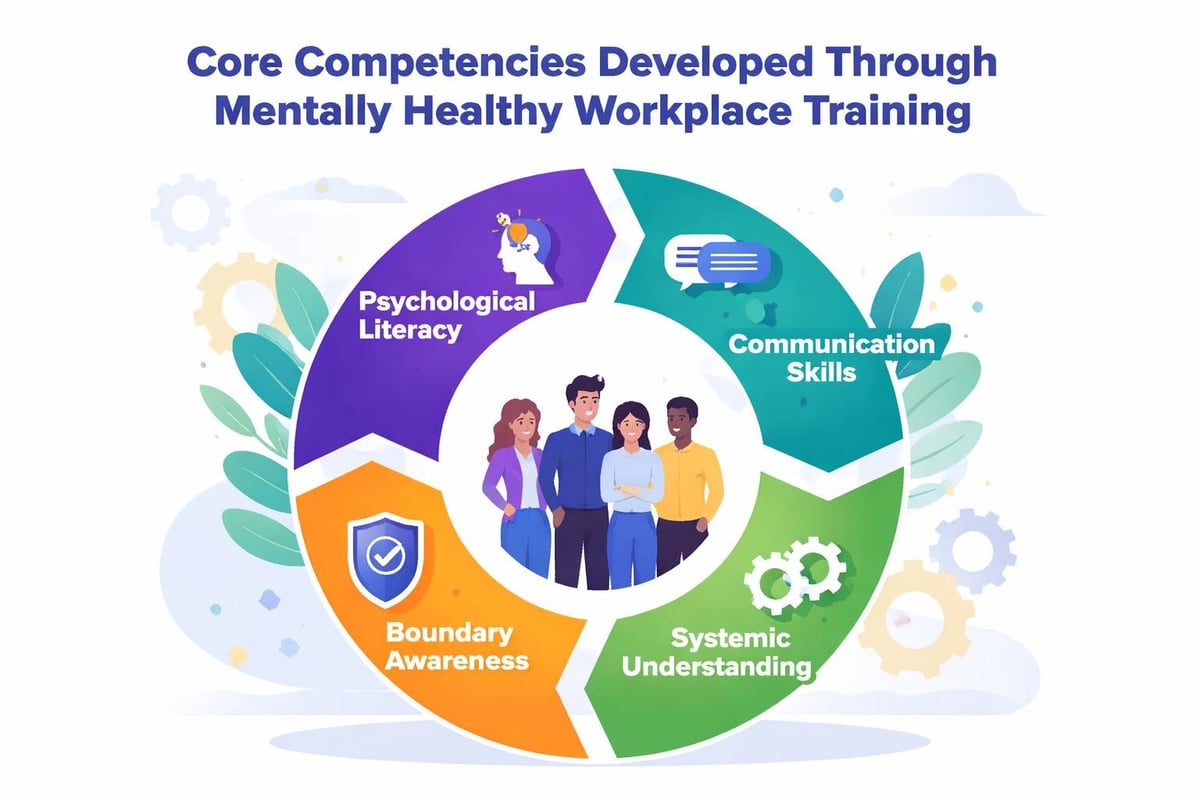
The foundation of mentally healthy workplace training rests on several interconnected elements that work synergistically:
- Psychological literacy: Understanding common mental health conditions, stress responses, and recovery processes
- Communication frameworks: Structured approaches to initiating and maintaining supportive conversations
- Boundary management: Recognizing professional limitations and appropriate referral pathways
- Self-care practices: Sustainable strategies for maintaining personal wellbeing while supporting others
- Systemic awareness: Understanding how organizational factors influence mental health outcomes
These components align with evidence-based training approaches that emphasize practical skill development over theoretical knowledge alone.
Research demonstrates that comprehensive training programs reduce stigma, increase early intervention rates, and improve help-seeking behaviors across organizational settings. The measurable outcomes extend beyond individual knowledge gains to observable behavioral changes in how teams respond to psychological distress.
Designing Training for Different Organizational Roles
Effective mentally healthy workplace training recognizes that managers, human resources professionals, and frontline employees require distinct yet complementary skill sets. Differentiated learning pathways ensure relevance and maximize practical application.
Manager-Specific Training Modules
Managers occupy a unique position where their behavior and competence disproportionately influence team psychological safety. Their training must address:
- Recognition skills: Identifying changes in performance, behavior, or presentation that may indicate psychological distress
- Conversation frameworks: Structured approaches like the four-step support conversation model
- Adjustment protocols: Implementing reasonable workplace modifications while maintaining operational requirements
- Documentation practices: Recording concerns and actions appropriately while respecting privacy
- Escalation pathways: Knowing when and how to involve HR, employee assistance programs, or external resources
Psychological safety training for leaders creates the foundation for teams to communicate openly about challenges before they escalate into crises.
Employee-Level Training Design
Employee-focused mentally healthy workplace training emphasizes personal resilience, peer support capabilities, and organizational resource awareness. This tier builds collective responsibility rather than concentrating all mental health competency in management.
| Training Focus | Manager Programs | Employee Programs | HR/Leadership Programs |
|---|---|---|---|
| Primary Objective | Team support and reasonable adjustments | Personal resilience and peer awareness | Strategic policy and culture development |
| Conversation Depth | Structured support conversations | Recognition and referral | Complex case management |
| System Knowledge | Immediate resources and referral | Available support services | Full spectrum of organizational response |
| Duration | 8-16 hours typically | 4-8 hours typically | 16-24 hours including strategy |
The NSW Government’s evidence-based training programs demonstrate how tailored content for different organizational levels creates comprehensive capability across the workforce.
Implementation Strategies That Drive Adoption
Even expertly designed mentally healthy workplace training fails without thoughtful implementation. Organizations must address practical barriers, cultural resistance, and sustainability challenges from the outset.
Addressing Common Implementation Barriers
Several predictable obstacles undermine training effectiveness:
Time constraints: Compressed schedules reduce learning depth and skill practice opportunities. Successful programs either secure protected learning time or design modular content that accommodates operational realities without sacrificing core competencies.
Leadership skepticism: When senior leaders question training value, participation rates suffer and cultural permission to apply skills diminishes. Demonstrating return on investment through reduced absenteeism, improved retention, and enhanced productivity metrics addresses this resistance.
Competing priorities: Mental health training competes with technical skills development, compliance requirements, and operational demands. Positioning mental health competency as foundational to team performance rather than supplementary aligns it with business objectives.
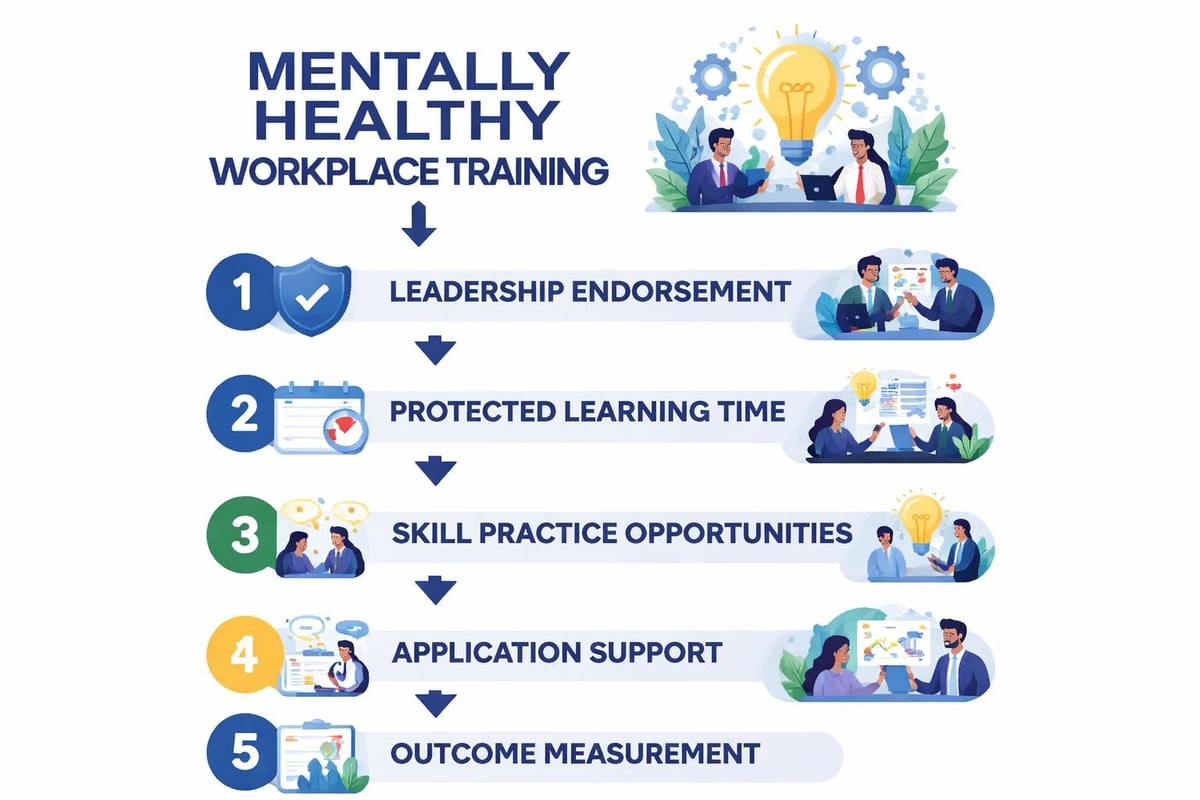
Organizations achieve higher adoption rates when they integrate training into existing professional development frameworks rather than positioning it as an additional burden. Mental Health First Aid workplace programs exemplify this integration approach.
Creating Sustainable Learning Ecosystems
Single training events create temporary awareness but rarely produce lasting behavior change. Sustainable mentally healthy workplace training requires:
- Refresher sessions: Scheduled reviews that reinforce skills and update content based on emerging evidence
- Practice opportunities: Structured scenarios, role-plays, and case discussions that build confidence
- Peer learning communities: Regular forums where participants share experiences and problem-solve together
- Leadership modeling: Visible application of skills by senior leaders that normalizes supportive behaviors
- Resource accessibility: Just-in-time tools and frameworks available when real situations arise
Australian organizations benefit from accessing locally relevant resources through specialized training providers that understand regional workplace contexts and regulatory frameworks.
Measuring Training Effectiveness and Impact
Robust evaluation distinguishes mentally healthy workplace training from performative initiatives. Organizations require evidence that investments translate into meaningful outcomes across multiple measurement horizons.
Immediate Learning Outcomes
Post-training assessment captures knowledge acquisition and initial confidence levels:
- Knowledge tests: Validated instruments measuring understanding of core concepts
- Skill demonstrations: Observed practice of key techniques like conversation initiation
- Confidence ratings: Self-reported readiness to apply skills in workplace contexts
- Intention measures: Commitment to specific behaviors following training completion
These immediate metrics establish baseline capability but provide limited insight into sustained application under real workplace conditions.
Behavioral and Organizational Indicators
Medium-term evaluation focuses on observable behavior changes and system-level impacts:
- Manager-employee conversation frequency regarding wellbeing topics
- Employee assistance program utilization patterns
- Early intervention rates before performance deterioration
- Reasonable adjustment implementation consistency
- Peer support network activation
Building psychologically safe cultures requires measuring not just individual competency but team-level psychological safety indicators that reflect collective capability.
Long-Term Organizational Outcomes
Strategic evaluation examines enterprise-level impacts over extended timeframes:
| Outcome Domain | Measurement Approach | Typical Timeline | Interpretation Considerations |
|---|---|---|---|
| Absenteeism rates | Days lost per employee annually | 12-24 months | Control for seasonal variation and organizational changes |
| Presenteeism impact | Validated productivity scales | 6-18 months | Requires baseline measurement before training |
| Retention patterns | Turnover rates by department | 18-36 months | Isolate training effect from market conditions |
| Workers' compensation | Psychological injury claims | 24-48 months | Account for reporting practice changes |
Advanced organizations employ algorithmic approaches to detect stress patterns and evaluate intervention effectiveness, as demonstrated in recent workplace mental health research.
Advanced Topics in Workplace Mental Health Education
As organizations mature beyond foundational awareness, mentally healthy workplace training must address complex scenarios that demand sophisticated judgment and nuanced understanding.
Trauma-Informed Practice Integration
Trauma-informed approaches recognize that many employees have experienced adversity that shapes their workplace interactions and stress responses. Advanced training equips participants to:
Recognize trauma responses: Understanding that hypervigilance, avoidance, or disproportionate reactions may reflect historical experiences rather than current workplace dynamics.
Modify communication approaches: Adapting language, providing choice, and ensuring predictability in ways that reduce re-traumatization risk.
Create safety-oriented systems: Designing processes that minimize power imbalances and maximize employee control over their work environment.
Organizations serving high-trauma populations or operating in crisis-prone sectors require this advanced capability as standard rather than specialized training.
Cultural Competency in Mental Health Support
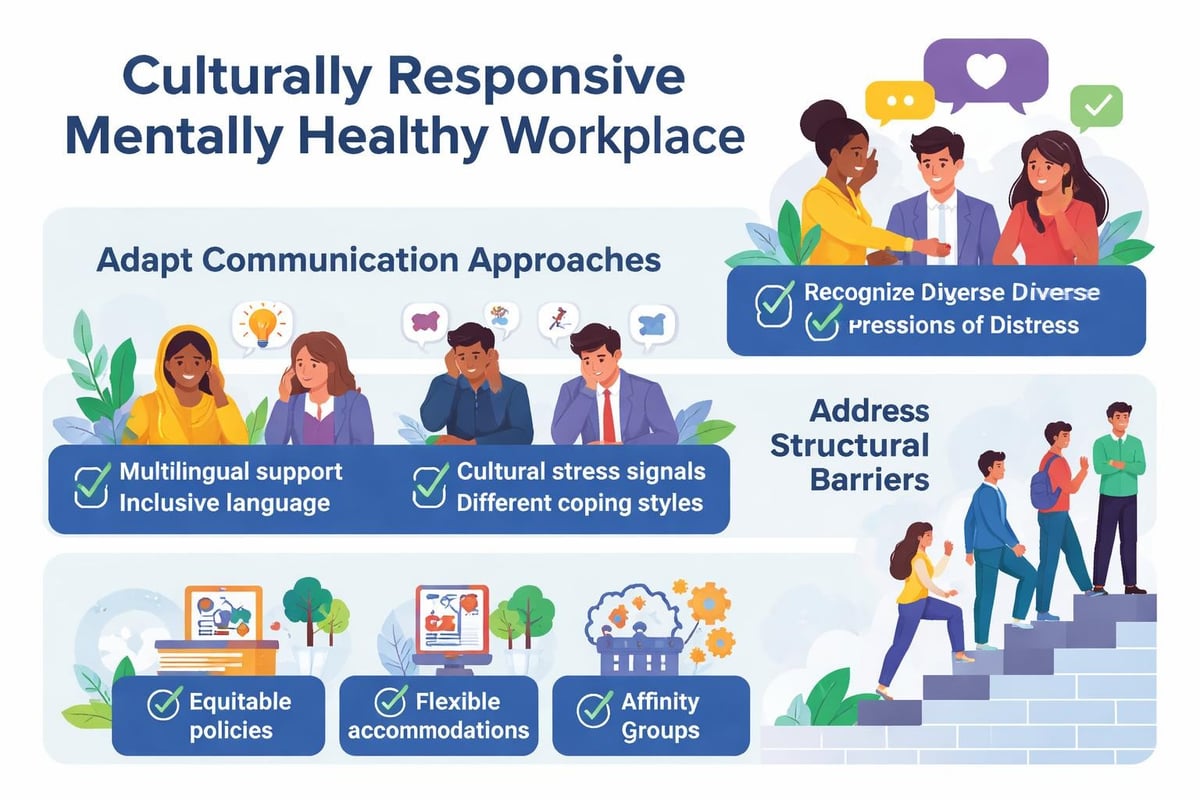
Mentally healthy workplace training must acknowledge that mental health literacy, help-seeking behaviors, and communication preferences vary significantly across cultural contexts. Culturally responsive programs address:
- Varied expressions of psychological distress across cultural backgrounds
- Different conceptual frameworks for understanding mental health and recovery
- Communication style preferences that influence conversation effectiveness
- Structural barriers affecting specific demographic groups' access to support
- Collective versus individualistic approaches to wellbeing
Generic training that assumes universal responses to psychological distress fails diverse workforces and potentially reinforces existing inequities.
Managing Complex Presentations
Frontline managers increasingly encounter situations involving crisis risk, complex co-occurring conditions, or deteriorating performance alongside mental health concerns. Advanced mentally healthy workplace training develops capability in:
- Risk assessment fundamentals: Recognizing crisis indicators without attempting clinical diagnosis
- Multi-system coordination: Collaborating with HR, EAP providers, healthcare professionals, and external services
- Confidentiality navigation: Balancing privacy obligations with safety responsibilities and operational requirements
- Performance management integration: Addressing work quality issues while maintaining compassionate support
- Boundary maintenance: Sustaining supportive relationships without assuming therapeutic roles
The two-day intensive programs offered by specialized providers exemplify the depth required for complex scenario capability.
Integration With Broader Wellbeing Strategies
Mentally healthy workplace training achieves maximum impact when embedded within comprehensive organizational wellbeing frameworks rather than operating as isolated initiatives.
Alignment With Psychosocial Hazard Management
Regulatory environments increasingly require systematic identification and control of psychosocial hazards. Training complements hazard management by:
Building assessment capability: Equipping managers to recognize when job demands, role clarity issues, or interpersonal conflicts create psychological risk.
Supporting control implementation: Developing skills to modify work arrangements, improve team dynamics, and reduce exposure to identified hazards.
Monitoring effectiveness: Enabling frontline observation of whether implemented controls actually reduce distress and improve functioning.
Organizations that separate training from systematic hazard management miss opportunities for integrated approaches where education directly supports risk reduction.
Connecting to Strategic Workforce Planning
Forward-thinking organizations recognize mentally healthy workplace training as workforce development infrastructure that influences recruitment, retention, and succession planning:
- Recruitment attraction: Publicized mental health capability differentiates employers in competitive talent markets
- Onboarding integration: Early exposure to supportive culture and available resources accelerates psychological safety
- Career development pathways: Mental health competency as recognized leadership capability and promotion criterion
- Succession preparedness: Building bench strength in roles requiring high emotional intelligence and support skills
This strategic integration positions mental health capability as core business competency rather than peripheral human resources function. Organizations can explore comprehensive approaches through specialized training platforms designed for scalable implementation.
Policy and Practice Coherence
Training effectiveness depends heavily on alignment between learned skills and organizational policies, systems, and leadership behaviors. Contradictions undermine credibility and application:
Inconsistent messaging: Training emphasizes openness while policies penalize vulnerability or disclosure.
Resource gaps: Skills development without corresponding support infrastructure leaves managers equipped but unsupported.
Leadership modeling: Senior leaders who ignore or contradict training principles signal that application carries career risk.
Coherent implementation requires simultaneous attention to capability development, system design, policy alignment, and cultural modeling. The Workplace Mental Health Institute approach integrates these elements through combined training and strategic consultation.
Technology-Enhanced Learning Approaches
Digital platforms expand mentally healthy workplace training accessibility while introducing quality control challenges. Organizations must balance convenience against learning effectiveness.
Online Versus Blended Modalities
Self-paced digital learning offers flexibility and scalability but lacks the skill practice and peer interaction critical for confidence development. Blended approaches combining online foundational content with facilitated practice sessions optimize both efficiency and effectiveness.
Pure online strengths: Accessibility for distributed workforces, self-directed pacing, cost efficiency at scale, consistent content delivery.
Pure online limitations: Reduced skill practice opportunities, limited peer learning, decreased facilitator adaptation to participant needs, higher non-completion rates.
Blended optimization: Online modules for knowledge building, virtual or in-person sessions for skill practice, ongoing digital resources for application support, community platforms for peer connection.
Organizations should select modalities based on learning objectives rather than convenience alone. Conversational skills and complex judgment development require interactive practice that purely digital formats struggle to provide.
Virtual Reality and Simulation Applications
Emerging technologies create safe practice environments for difficult conversations and crisis response scenarios. While implementation costs remain significant, simulation-based learning offers:
- Repeatable practice without real-world consequences
- Standardized scenario presentation for assessment purposes
- Immediate feedback on communication choices and intervention approaches
- Confidence building through graduated difficulty progression
As these technologies mature and costs decrease, they will likely become standard components of comprehensive mentally healthy workplace training programs.
Mentally healthy workplace training represents essential organizational infrastructure that builds capability, reduces risk, and improves outcomes when designed and implemented with rigor. The distinction between superficial programs and transformative interventions lies in their depth, integration with broader systems, and sustained commitment to skill development. Organizations ready to move beyond awareness campaigns toward genuine capability building will find that Workplace Mental Health Institute offers evidence-informed programs, strategic consultation, and implementation support tailored to create measurable, lasting impact on both employee wellbeing and organizational performance.

