
Organizations worldwide are recognizing that employee mental health represents a strategic business priority, not merely a compliance obligation. Mental wellbeing training has emerged as a foundational intervention that equips leaders, managers, and employees with evidence-based skills to recognize, respond to, and prevent mental health challenges in the workplace. When implemented systematically, these programs reduce absenteeism, enhance productivity, and create psychologically safe environments where people can perform at their best. The question facing organizational leaders is not whether to invest in mental wellbeing training, but how to design and deliver programs that produce measurable, lasting outcomes.
Defining Mental Wellbeing Training in Organizational Contexts
Mental wellbeing training encompasses structured learning interventions designed to build mental health literacy, psychological skills, and supportive behaviors across all organizational levels. Unlike awareness campaigns that simply disseminate information, effective training programs develop specific competencies through active learning methods.
Core Components of Comprehensive Programs
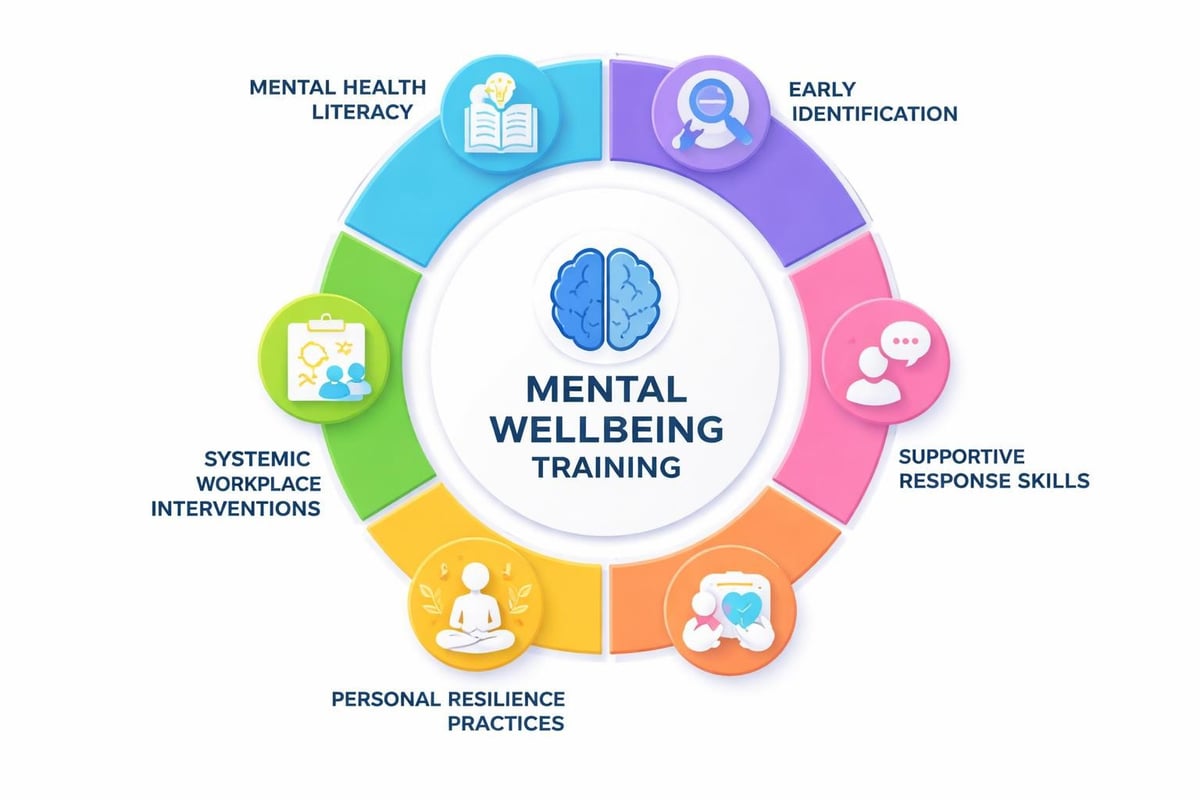
Professional mental wellbeing training typically addresses multiple competency domains simultaneously:
- Mental health literacy: Understanding common mental health conditions, their workplace manifestations, and evidence-based treatments
- Early identification skills: Recognizing behavioral, emotional, and performance changes that may indicate psychological distress
- Response capabilities: Conducting supportive conversations, making appropriate referrals, and managing crisis situations
- Self-care practices: Building personal resilience through stress management, boundary setting, and recovery strategies
- Systemic interventions: Identifying and addressing organizational factors that impact mental health outcomes
The World Health Organization’s QualityRights e-training emphasizes rights-based approaches that respect dignity and autonomy while supporting recovery and wellbeing.
Distinguishing Training from Therapy
A critical distinction exists between mental wellbeing training and clinical treatment. Training programs equip participants with knowledge and skills to support mental health within their roles. They do not transform participants into therapists or diagnosticians. Effective programs establish clear boundaries around professional scope, emphasize connection to appropriate resources, and focus on creating supportive environments rather than providing treatment.
Strategic Implementation for Managers and Leaders
Managers occupy a unique position in organizational mental health ecosystems. They influence team culture, workload distribution, communication patterns, and access to support resources. Mental wellbeing training for managers generates disproportionate impact because of their multiplier effect across teams.
Manager-Specific Training Outcomes
Organizations should expect manager-focused mental wellbeing training to develop these capabilities:
| Capability Area | Specific Skills | Measurable Indicators |
|---|---|---|
| Psychological Safety | Creating conditions for disclosure, responding non-judgmentally | Team engagement scores, disclosure rates |
| Workload Management | Identifying stress signals, adjusting demands appropriately | Burnout metrics, absence patterns |
| Supportive Conversations | Active listening, empathy, appropriate questioning | Manager confidence ratings, employee feedback |
| Resource Navigation | Connecting team members with EAP, accommodations, professional support | Utilization rates, time to support |
| Cultural Influence | Modeling healthy behaviors, normalizing help-seeking | Team psychological safety scores |
Workplace Mental Health Institute's comprehensive training programs specifically address these manager competencies through scenario-based learning and practical skill development.
Overcoming Implementation Barriers
Leaders frequently encounter resistance when introducing mental wellbeing training. Common concerns include time constraints, skepticism about effectiveness, and fear of inadequacy. Addressing these barriers requires:
Framing training as capability development rather than problem identification creates a growth-oriented approach. Managers develop valuable skills that enhance their leadership effectiveness across all situations, not just mental health crises.
Providing protected time signals organizational commitment. When training occurs during work hours without competing demands, participation and engagement increase substantially.
Establishing psychological safety before training begins allows managers to acknowledge uncertainty and ask questions without fear of judgment. Pre-training communications should normalize learning curves and emphasize that expertise develops gradually.
Evidence-Based Curriculum Design Principles
The effectiveness of mental wellbeing training depends heavily on instructional design quality. Research-informed programs incorporate specific elements that enhance learning transfer and behavioral change.
Active Learning Methodologies
Passive information delivery produces minimal behavioral change. Effective mental wellbeing training prioritizes:
- Scenario-based exercises that simulate realistic workplace situations requiring judgment and response
- Role-play activities that build conversational skills through practice with feedback
- Case study analysis that develops pattern recognition and decision-making capabilities
- Reflection exercises that connect new learning to personal experience and organizational context
- Action planning that translates insights into specific behavioral commitments
Research on designing experiences that support psychological wellbeing provides evidence-based frameworks for structuring learning interventions that promote lasting change.
Trauma-Informed Training Approaches
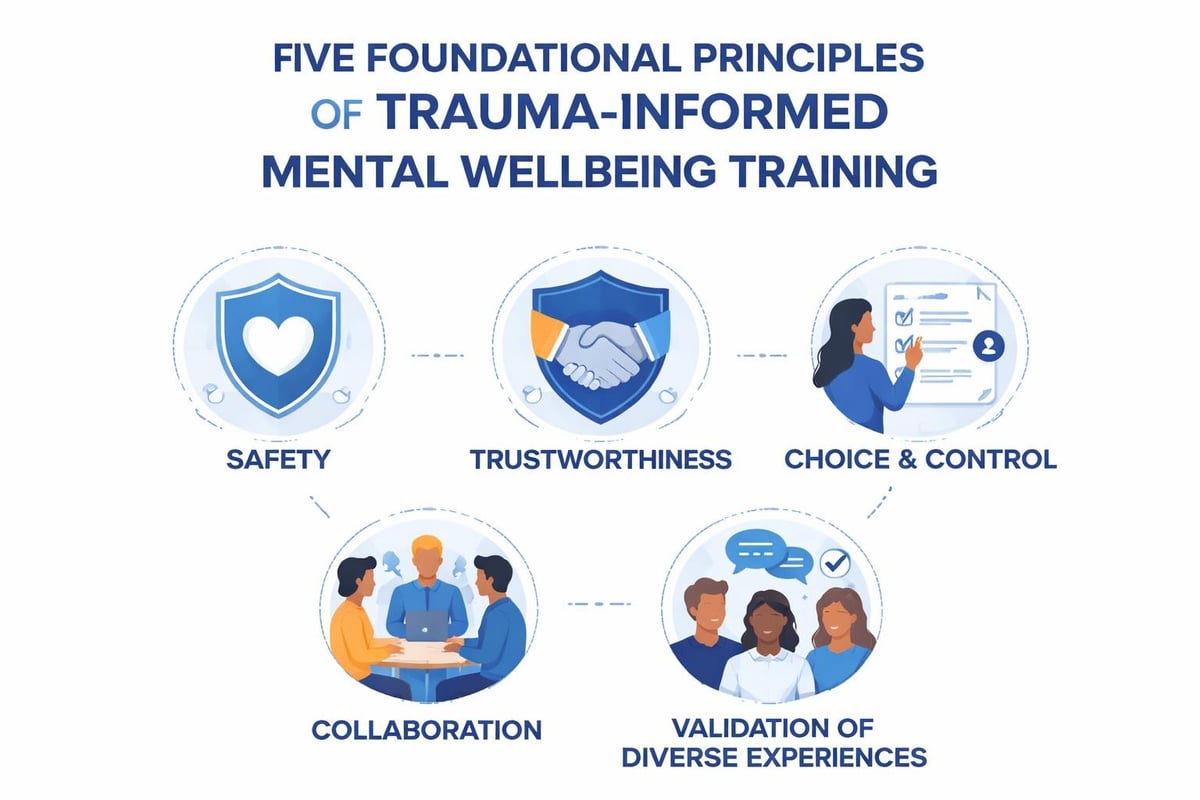
Contemporary mental wellbeing training increasingly incorporates trauma-informed principles, recognizing that many employees have experienced adversity that shapes their workplace functioning. Trauma-informed training:
- Emphasizes physical and psychological safety throughout the learning environment
- Builds trustworthiness through consistency, transparency, and clear expectations
- Provides choice and control over participation levels and disclosure
- Encourages collaboration rather than hierarchical instruction
- Validates diverse experiences and responses to workplace stress
These principles apply both to how training is delivered and to the response skills being taught. Organizations seeking specialized expertise can access trauma-informed care training designed specifically for workplace applications.
Measuring Training Effectiveness and Organizational Impact
Rigorous evaluation distinguishes high-quality mental wellbeing training from performative initiatives. Organizations should implement multi-level assessment frameworks that capture immediate learning outcomes, behavioral changes, and organizational results.
The Kirkpatrick Framework Applied to Mental Health Training
This established evaluation model provides structure for comprehensive assessment:
Level 1 – Reaction: Participant satisfaction, perceived relevance, and engagement during training sessions provide immediate feedback but limited predictive value for outcomes.
Level 2 – Learning: Knowledge assessments, skill demonstrations, and confidence ratings indicate whether participants acquired intended competencies. Pre-post comparisons reveal learning gains.
Level 3 – Behavior: Observational assessments, 360-degree feedback, and behavioral frequency tracking determine whether participants apply learned skills in workplace situations. This level requires follow-up measurement weeks or months post-training.
Level 4 – Results: Organizational metrics including absence rates, turnover, productivity indicators, safety incidents, and engagement scores reveal business impact. Attribution requires careful analysis and comparison groups when possible.
Leading and Lagging Indicators
Comprehensive evaluation tracks both immediate and delayed outcomes:
| Indicator Type | Metrics | Timeline |
|---|---|---|
| Leading | Manager confidence, knowledge scores, help-seeking intentions | Immediate to 1 month |
| Leading | Conversation frequency, resource utilization, psychological safety perceptions | 1-3 months |
| Lagging | Absence reduction, turnover rates, workers' compensation claims | 3-12 months |
| Lagging | Productivity metrics, engagement scores, healthcare cost trends | 6-24 months |
The National Council for Mental Wellbeing emphasizes the importance of sustained measurement to capture the full impact of transformative mental health training.
Building Organizational Capacity Beyond Individual Training
While individual skill development forms the foundation of mental wellbeing training, sustainable organizational change requires systems-level interventions that reinforce and extend training outcomes.
Creating Supportive Infrastructure
Training effectiveness multiplies when organizations establish:
Clear referral pathways that connect concerned colleagues to appropriate resources without confusion or delay. Documented procedures, updated contact information, and regular communication ensure accessibility.
Ongoing consultation access allows trained managers to seek guidance when facing complex situations beyond their expertise. Whether through internal specialists or external consultants, this safety net prevents paralysis and supports appropriate responses.
Refresher and advanced training recognizes that skills decay without practice and reinforcement. Annual updates, specialized modules, and peer learning opportunities maintain and deepen capabilities over time.
Policy Alignment and Cultural Integration
Training initiatives fail when organizational policies and cultural norms contradict taught principles. Alignment requires:
- Leave policies that provide adequate mental health recovery time without punitive consequences
- Workload expectations that allow sustainable performance without chronic overwork
- Performance management that addresses mental health impacts on productivity compassionately and constructively
- Leadership modeling where senior executives demonstrate healthy boundaries and help-seeking behaviors
Organizations can access workplace wellbeing assessments to identify policy gaps and cultural barriers that undermine training effectiveness.
Specialized Training for High-Risk and High-Impact Roles
Certain organizational roles warrant enhanced mental wellbeing training due to elevated exposure to traumatic material, high-stress situations, or significant responsibility for others' wellbeing.
Roles Requiring Advanced Training
First responders and safety personnel encounter traumatic situations regularly, requiring specialized training in psychological first aid, peer support, and post-incident protocols.
Customer-facing employees in healthcare, social services, and public safety manage emotionally demanding interactions that accumulate psychological strain. Training emphasizes emotional regulation, boundary management, and vicarious trauma prevention.
Human resources professionals handle sensitive disclosures and support employees through crises, necessitating advanced conversational skills and comprehensive resource knowledge.
Executive leaders shape organizational culture and make decisions with broad mental health implications, requiring strategic thinking about systemic wellbeing alongside individual support skills.
Tailoring Content to Organizational Context
Generic mental wellbeing training produces suboptimal results. Effective programs incorporate:
- Industry-specific scenarios reflecting actual workplace challenges
- Role-appropriate response options aligned with authority and responsibilities
- Organizational resource information including internal and external supports
- Cultural considerations relevant to the workforce demographic composition
- Regulatory compliance requirements specific to the jurisdiction and sector
Organizations benefit from working with providers who customize content rather than delivering standardized packages. Australian organizations can access regionally tailored programs addressing local workplace safety legislation and cultural contexts.
Integration with Broader Wellbeing Strategies
Mental wellbeing training achieves maximum impact when embedded within comprehensive workplace health strategies that address multiple determinants of employee wellness.
The Multilevel Prevention Framework
Effective organizational mental health strategies operate at three intervention levels:
Primary prevention reduces risk by addressing work design, organizational culture, and systemic stressors before harm occurs. Training contributes by building mental health literacy and normalizing proactive wellbeing practices.
Secondary prevention identifies emerging issues early and provides timely support to prevent escalation. Training develops the recognition and response skills that enable early intervention.
Tertiary prevention supports recovery and return to work for employees experiencing significant mental health challenges. Training ensures managers can facilitate accommodations and maintain supportive team environments during recovery periods.
Complementary Organizational Initiatives
Mental wellbeing training complements rather than replaces other wellbeing investments:
- Employee Assistance Programs provide confidential professional support that training prepares employees to access
- Workplace flexibility policies reduce structural stressors that training alone cannot address
- Physical health programs recognize the bidirectional relationship between physical and mental wellbeing
- Professional development opportunities build competence and autonomy that enhance psychological wellbeing
- Social connection initiatives strengthen relationships that buffer against stress and isolation
Technology-Enhanced Training Delivery Models
Digital platforms expand access to mental wellbeing training while introducing considerations around engagement, interaction quality, and learning effectiveness.
Comparing Delivery Modalities
| Delivery Method | Advantages | Limitations | Optimal Applications |
|---|---|---|---|
| In-person workshops | High interaction, relationship building, immediate feedback | Geographic constraints, scheduling complexity, higher costs | Skill practice, sensitive topics, team building |
| Live virtual training | Accessibility, cost efficiency, recording capability | Attention challenges, limited non-verbal cues | Knowledge transfer, large groups, geographically distributed teams |
| Self-paced online modules | Flexibility, standardization, scalability | Lower engagement, minimal interaction, self-discipline required | Foundational knowledge, refresher content, prerequisite learning |
| Blended approaches | Combines modality strengths, accommodates preferences | Design complexity, technology requirements | Comprehensive programs balancing efficiency and effectiveness |
The Workplace Mental Health Institute’s online courses demonstrate how digital delivery can maintain rigor and engagement through expert-designed content and interactive elements.
Ensuring Quality in Digital Training
Technology-mediated mental wellbeing training requires intentional design to overcome inherent limitations:
Interactive elements including polls, breakout discussions, and chat-based exercises maintain engagement and enable practice. Passive video watching produces minimal learning transfer.
Production quality affects credibility and attention. Professional audio, clear visuals, and thoughtful pacing communicate organizational commitment and respect for participant time.
Accessibility features including captions, transcripts, and screen reader compatibility ensure inclusive participation across ability levels.
Follow-up mechanisms such as email prompts, discussion forums, and manager check-ins extend learning beyond the formal training window and support application.
Addressing Diverse Workforce Needs in Training Design
Effective mental wellbeing training acknowledges that employees bring varied backgrounds, experiences, and needs to the learning environment. Inclusive design enhances relevance and impact across diverse populations.
Cultural Responsiveness in Mental Health Training
Mental health concepts, help-seeking behaviors, and support preferences vary across cultural contexts. Culturally responsive training:
- Presents multiple perspectives on mental wellbeing rather than assuming universal definitions
- Includes diverse examples and case studies representing varied cultural backgrounds
- Acknowledges different attitudes toward disclosure, professional help, and family involvement
- Provides resources that serve multilingual and multicultural populations
- Invites participant knowledge as valuable rather than positioning trainers as sole experts
Generational Considerations
Workforce age diversity introduces varying mental health literacy levels, technology comfort, and workplace expectations. Training that serves multiple generations:
Avoids assumptions about baseline knowledge or comfort with mental health discussions, providing foundational concepts without condescension.
Offers choice in participation formats and intensity levels, allowing individuals to engage at their readiness level.
Bridges perspectives by facilitating intergenerational dialogue about changing workplace mental health norms and expectations.
Return on Investment and Business Case Development
Securing organizational commitment to mental wellbeing training requires demonstrating value in business terms alongside humanitarian arguments.
Quantifying Training Benefits
Research consistently demonstrates positive returns from mental health interventions:
- Absence reduction: Organizations implementing comprehensive mental health training report 15-30% decreases in mental health-related absences
- Productivity gains: Presenteeism reduction and engagement improvements translate to 5-10% productivity increases
- Turnover prevention: Supportive workplace cultures reduce voluntary turnover by 20-40%, saving recruitment and training costs
- Healthcare cost containment: Early intervention and prevention reduce expensive crisis care and long-term treatment needs
- Workers' compensation savings: Psychological injury claim frequency and severity decrease with proactive mental health cultures
Building the Business Case
Compelling proposals for mental wellbeing training investment include:
- Current state analysis documenting existing mental health impacts through absence data, engagement scores, exit interviews, and incident reports
- Evidence synthesis connecting training interventions to measurable outcomes through peer-reviewed research and case studies
- Cost-benefit projections estimating investment requirements against anticipated savings and productivity gains
- Implementation roadmap outlining phased deployment, evaluation methods, and success metrics
- Risk mitigation highlighting duty of care obligations, regulatory compliance, and reputational considerations
Organizations seeking strategic guidance can access workplace wellbeing consultation services that support business case development and implementation planning.
Sustaining Impact Through Continuous Improvement
Initial training deployment represents the beginning, not the conclusion, of organizational mental health capability development. Sustained impact requires ongoing assessment, refinement, and evolution.
Feedback Integration Processes
High-performing organizations establish systematic approaches to capturing and acting on training feedback:
Participant surveys administered immediately post-training and at follow-up intervals reveal satisfaction, learning gains, application challenges, and suggestions for improvement.
Manager focus groups provide qualitative insights into real-world application successes and obstacles that quantitative data may miss.
Utilization tracking monitors resource access patterns, conversation frequencies, and support service engagement to assess behavioral change.
Outcome monitoring analyzes organizational metrics for trends attributable to training interventions, acknowledging that multiple factors influence these indicators.
Adapting to Emerging Needs
Workplace mental health challenges evolve with changing work arrangements, economic conditions, and social contexts. Training programs require periodic updates addressing:
- Remote and hybrid work mental health considerations
- Economic uncertainty and job security stress
- Social and political polarization impacts on workplace relationships
- Emerging research on effective interventions and support approaches
- Regulatory changes affecting employer mental health responsibilities
Organizations can access current, evidence-based content through providers who regularly update curriculum based on emerging research and workplace trends. The Workplace Mental Health Institute YouTube channel offers ongoing insights and updates on contemporary workplace mental health topics.
Mental wellbeing training represents a strategic investment that builds organizational capacity to support employee psychological health while enhancing business performance through reduced absence, improved productivity, and stronger engagement. Effective programs combine evidence-based content, active learning methodologies, multi-level evaluation, and integration with broader workplace health strategies to produce measurable, sustainable outcomes. The Workplace Mental Health Institute provides comprehensive training programs, assessment services, and strategic consultation designed specifically for organizations committed to building psychologically healthy workplaces where both people and performance thrive.

