
Mental health awareness at work has evolved from a peripheral concern to a central pillar of organizational strategy. Leaders and human resources professionals now recognize that employee psychological wellbeing directly influences productivity, retention, innovation, and workplace culture. Organizations that prioritize mental health awareness at work create environments where employees feel supported, valued, and equipped to perform at their best while maintaining their psychological health.
Understanding Mental Health Awareness in Professional Settings
Mental health awareness at work encompasses the recognition, understanding, and proactive management of psychological wellbeing within organizational contexts. This extends beyond basic awareness campaigns to include comprehensive systems that identify risk factors, reduce stigma, and implement evidence-based interventions.
According to the World Health Organization’s guidelines on workplace mental health, depression and anxiety alone cost the global economy approximately $1 trillion annually in lost productivity. These figures underscore why mental health awareness at work represents both a moral imperative and a strategic business priority.
Key Components of Effective Awareness Programs
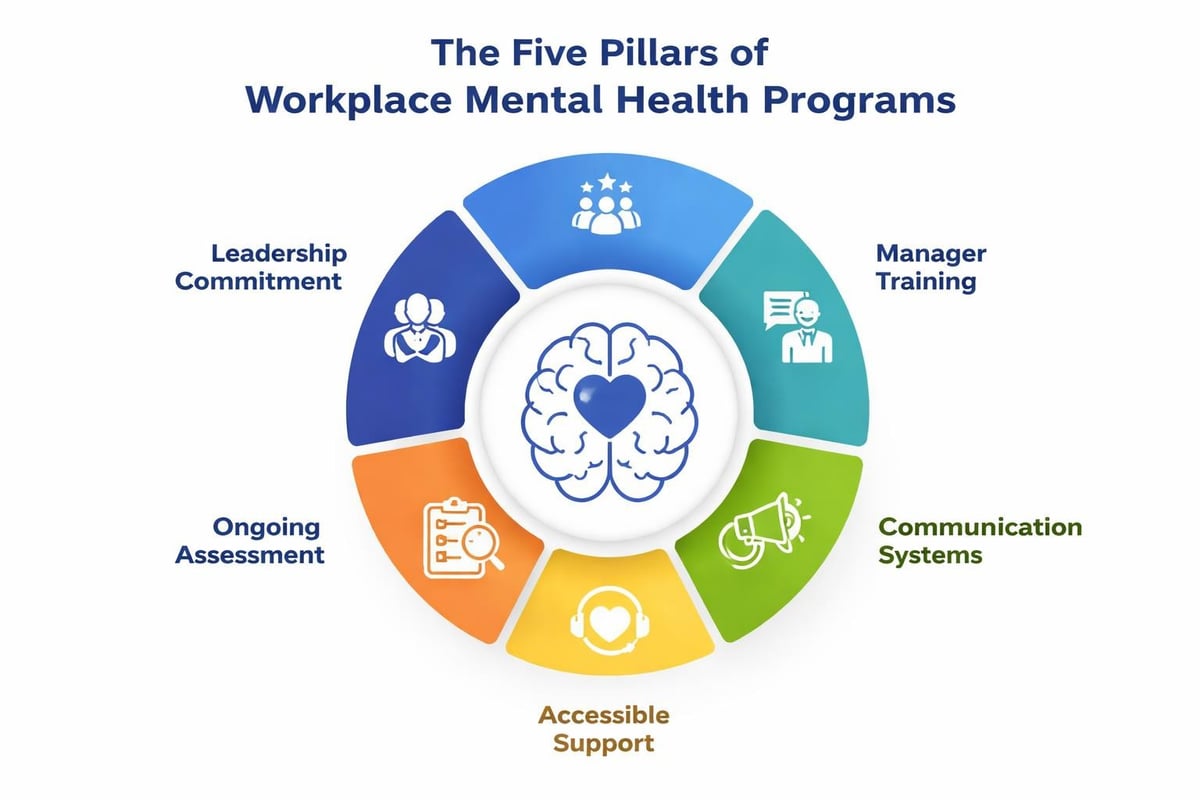
Organizations that successfully integrate mental health awareness at work typically establish multiple interconnected components:
- Leadership commitment demonstrated through policies, resource allocation, and personal advocacy
- Education and training for managers to recognize early warning signs and respond appropriately
- Clear communication channels that normalize mental health conversations
- Accessible support systems including employee assistance programs and mental health resources
- Regular assessment of workplace psychosocial risk factors
These elements work synergistically to create a culture where mental health receives the same attention and resources as physical safety.
The Business Case for Mental Health Awareness
Mental health awareness at work directly correlates with measurable organizational outcomes. Research demonstrates that employees experiencing psychological distress show reduced concentration, increased absenteeism, and higher turnover rates.
| Metric | Organizations with Strong Mental Health Awareness | Organizations with Limited Awareness |
|---|---|---|
| Absenteeism Rate | 3-5 days annually | 8-12 days annually |
| Employee Retention | 85-90% | 65-75% |
| Productivity Loss | 5-8% | 15-25% |
| Healthcare Costs | Baseline | 20-30% higher |
The CDC’s workplace mental health resources highlight that workplaces play a significant role in both contributing to and alleviating mental health challenges. Organizations cannot afford to ignore this dual responsibility.
Financial Returns on Investment
Mental health awareness at work generates substantial returns through multiple channels. Organizations implementing comprehensive programs typically see reduced disability claims, lower recruitment costs, decreased presenteeism, and improved employee engagement scores.
Studies indicate that every dollar invested in mental health awareness and treatment yields approximately four dollars in improved productivity and reduced healthcare expenses. This return on investment makes mental health awareness at work one of the most cost-effective organizational interventions available.
Building Manager Capability Through Training
Managers represent the frontline of mental health awareness at work. Their daily interactions, decision-making authority, and influence on team culture position them as critical agents of psychological safety and support.
Essential Manager Competencies
Effective mental health awareness at work requires managers to develop specific capabilities:
- Recognition skills to identify behavioral changes indicating psychological distress
- Communication techniques for approaching sensitive conversations with empathy
- Boundary awareness to provide support without assuming therapeutic roles
- Resource knowledge to direct employees toward appropriate professional assistance
- Self-care practices to maintain their own psychological wellbeing while supporting others
The CDC’s guidance on mental health conversations emphasizes that supportive dialogues require preparation, active listening, and clear understanding of available resources.
Trauma-informed approaches enhance manager effectiveness by recognizing how past experiences influence current behavior and stress responses. Managers trained in these frameworks create safer environments for employees managing psychological challenges.
Identifying and Managing Psychosocial Risks
Mental health awareness at work must extend beyond individual support to address systemic workplace factors that influence psychological wellbeing. Psychosocial risks represent conditions and organizational practices that may harm mental health.
Common Workplace Psychosocial Hazards
Organizations should regularly assess and mitigate these risk factors:
- Excessive workload that prevents recovery and work-life balance
- Role ambiguity creating uncertainty about responsibilities and expectations
- Limited autonomy reducing employees’ sense of control
- Poor workplace relationships including bullying, harassment, or social isolation
- Job insecurity generating chronic stress and anxiety
- Inadequate recognition diminishing motivation and self-worth
The WHO guidelines available through NCBI provide comprehensive frameworks for identifying and addressing these psychosocial risks through organizational interventions.
Assessment and Intervention Strategies
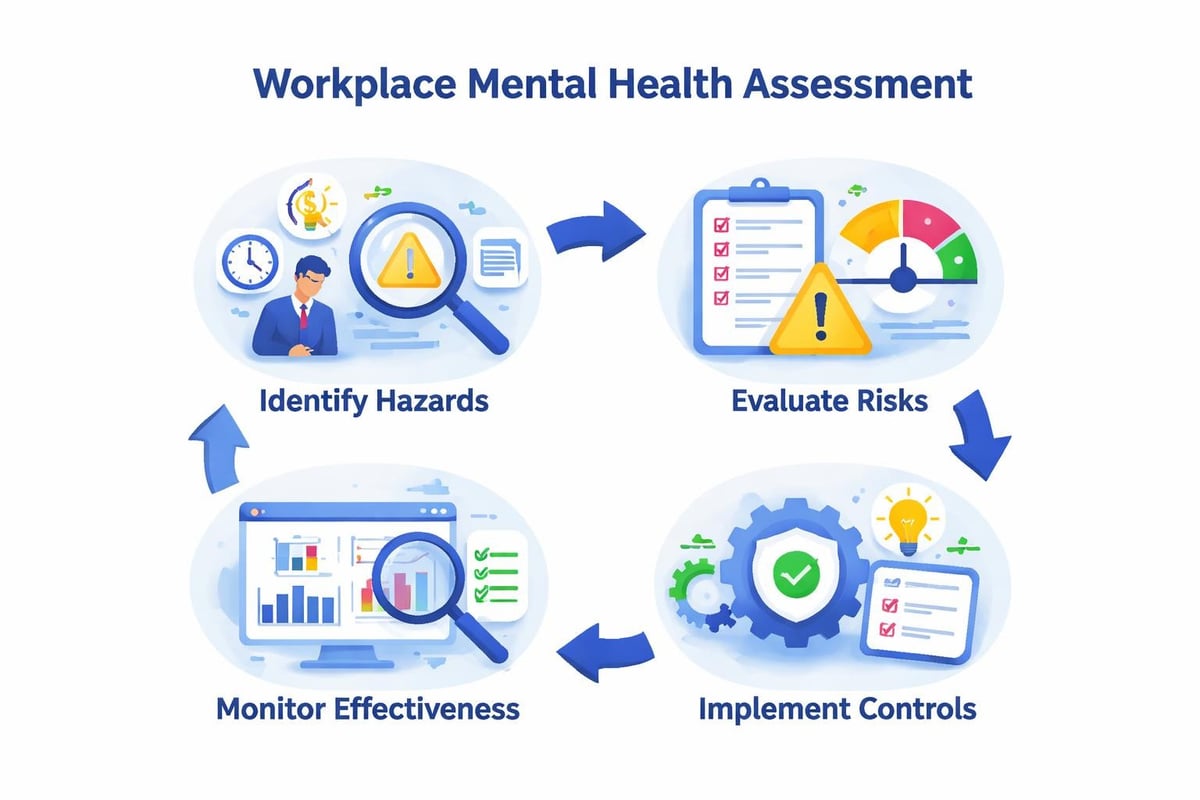
Mental health awareness at work requires structured approaches to evaluate organizational risks. Workplace wellbeing assessments measure factors including stress levels, job satisfaction, manager support, and psychological safety perceptions.
Organizations should conduct these assessments regularly, analyze patterns across departments and demographics, and develop targeted interventions addressing identified concerns. This data-driven approach ensures resources address actual needs rather than assumed problems.
Creating Psychologically Safe Workplace Cultures
Mental health awareness at work thrives in environments where employees feel safe discussing challenges without fear of judgment or professional consequences. Psychological safety represents a shared belief that the workplace is safe for interpersonal risk-taking.
Building Trust and Openness
Leaders cultivate psychological safety through consistent actions:
Modeling vulnerability by sharing appropriate challenges and demonstrating that seeking support represents strength rather than weakness establishes cultural norms. When senior leaders discuss their own mental health practices, employees recognize that wellbeing is universally valued.
Responding constructively to mental health disclosures reinforces that honesty receives support rather than punishment. Organizations must protect employees who seek assistance from negative career impacts.
Normalizing mental health through regular communication positions psychological wellbeing as a standard aspect of workplace conversation rather than a taboo topic requiring courage to address.
Practical Implementation Frameworks
Mental health awareness at work requires systematic implementation rather than isolated initiatives. Organizations benefit from structured frameworks that integrate awareness into existing systems and processes.
Phased Implementation Approach
| Phase | Duration | Key Activities | Success Indicators |
|---|---|---|---|
| Foundation | 3-6 months | Leadership alignment, policy development, baseline assessment | Executive commitment, approved policies |
| Capacity Building | 6-12 months | Manager training, resource establishment, communication campaigns | Trained managers, awareness metrics |
| Integration | 12-24 months | Embed into HR processes, ongoing training, support expansion | Utilization rates, cultural surveys |
| Optimization | Ongoing | Continuous improvement, advanced programs, outcome tracking | ROI demonstration, sustained engagement |
This phased approach allows organizations to build mental health awareness at work progressively, ensuring each stage establishes solid foundations for subsequent development.
Communication Strategies
Effective mental health awareness at work requires ongoing, multi-channel communication. Organizations should develop comprehensive communication plans incorporating:
- Regular leadership messages emphasizing mental health priority
- Educational content explaining available resources and access procedures
- Success stories demonstrating positive outcomes while protecting privacy
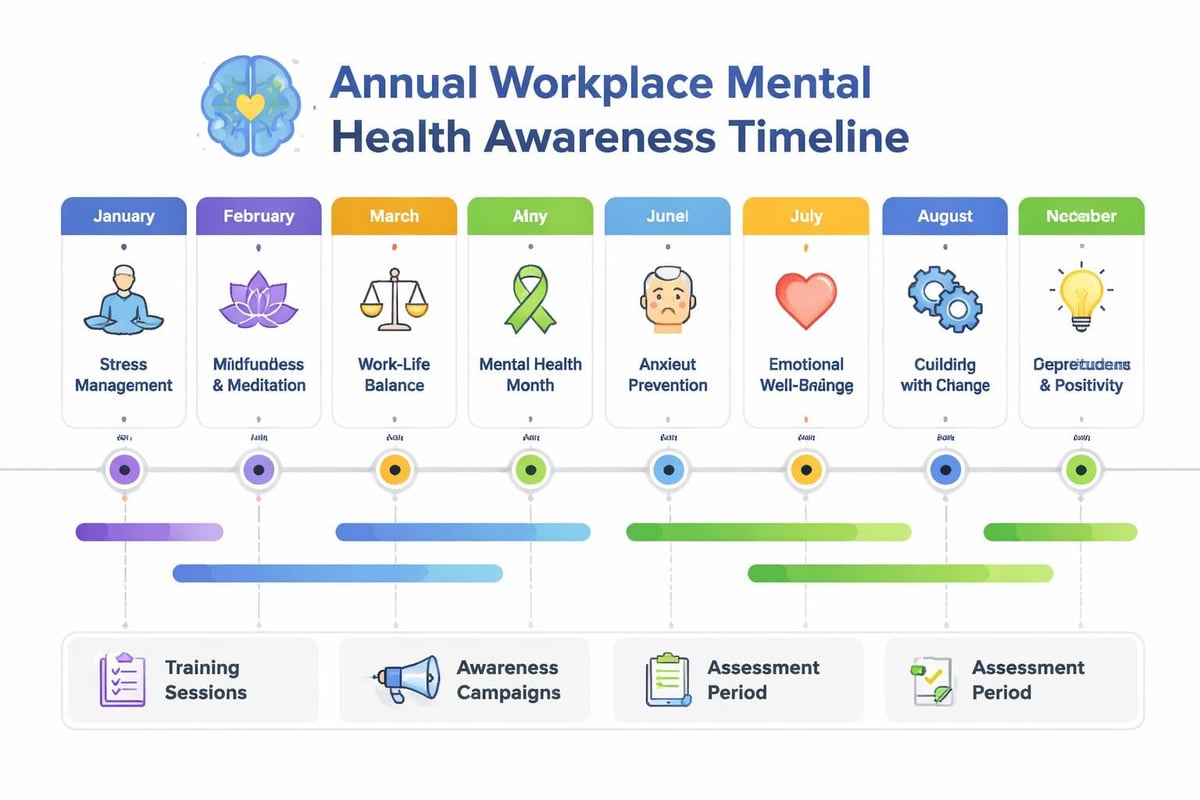
- Awareness campaigns during mental health observances
- Inclusive messaging addressing diverse employee populations and experiences
The American Psychiatric Association Foundation’s Center for Workplace Mental Health offers resources for developing effective workplace mental health programs across various organizational contexts.
Measuring Impact and Demonstrating Value
Mental health awareness at work requires accountability through systematic measurement. Organizations must track both process metrics (activities completed) and outcome metrics (results achieved) to demonstrate program effectiveness.
Key Performance Indicators
Comprehensive measurement frameworks include multiple dimensions:
- Awareness metrics measuring employee knowledge of available resources and support systems
- Utilization rates tracking employee assistance program engagement and mental health service access
- Climate indicators assessing psychological safety perceptions and stigma reduction
- Health outcomes monitoring stress levels, burnout rates, and overall wellbeing scores
- Business metrics evaluating absenteeism, turnover, productivity, and engagement changes
These measurements provide evidence of program impact and identify areas requiring additional attention or resources.
Continuous Improvement Cycles
Mental health awareness at work benefits from iterative refinement. Organizations should establish regular review cycles analyzing data, gathering employee feedback, benchmarking against similar organizations, and adjusting programs based on findings.
This continuous improvement approach ensures mental health awareness at work remains responsive to evolving employee needs and emerging evidence about effective interventions.
Addressing Diverse Workforce Needs
Mental health awareness at work must recognize that employees experience different stressors, possess varying cultural backgrounds, and require customized support approaches. One-size-fits-all programs fail to address the complexity of modern, diverse workforces.
Culturally Responsive Approaches
Organizations should adapt mental health awareness at work to reflect workforce diversity:
- Language accessibility providing resources in multiple languages employees speak
- Cultural competence recognizing how different cultures understand and express psychological distress
- Inclusive examples featuring diverse representations in training materials and communications
- Varied support options offering multiple pathways to assistance respecting different comfort levels
- Identity-specific resources addressing unique challenges faced by particular demographic groups
The CDC’s resources on mental health and substance use emphasize workplace interventions must consider the full spectrum of employee experiences and needs.
Supporting Remote and Hybrid Workers
Mental health awareness at work extends beyond traditional office environments. Remote and hybrid arrangements create distinct challenges including isolation, boundary management between work and personal life, and reduced access to informal support networks.
Organizations should develop specific strategies for distributed workforces, including virtual mental health resources, intentional connection opportunities, clear communication about availability expectations, and training for managers leading remote teams.
Legal and Ethical Considerations
Mental health awareness at work operates within complex legal frameworks protecting employee privacy while ensuring workplace safety. Organizations must balance these sometimes competing interests while maintaining ethical standards.
Privacy and Confidentiality
Employees sharing mental health information trust that disclosure remains confidential within appropriate boundaries. Organizations must establish clear protocols governing who accesses mental health information, how data is stored and protected, what circumstances require disclosure, and how privacy is maintained during workplace accommodations.
Mental health awareness at work includes educating managers about confidentiality requirements and appropriate responses to employee disclosures that avoid unauthorized information sharing.
Accommodation Requirements
Legal frameworks in most jurisdictions require reasonable accommodations for employees with mental health conditions. Organizations demonstrating strong mental health awareness at work proactively discuss accommodation options, implement flexible solutions, regularly review effectiveness, and adjust approaches as needs evolve.
These accommodations might include modified schedules, temporary workload adjustments, workspace modifications, or additional support during particularly stressful periods. For expert guidance on developing compliant and effective programs, organizations can contact specialized mental health training providers.
Building Resilience Alongside Awareness
Mental health awareness at work complements resilience development. While awareness focuses on recognition and support, resilience training equips employees with skills to manage stress, adapt to challenges, and maintain wellbeing amid adversity.
Core Resilience Competencies
Effective resilience programs develop specific capabilities:
- Stress management techniques including breathing exercises, mindfulness practices, and cognitive reframing
- Emotional regulation skills helping employees recognize and respond constructively to difficult emotions
- Problem-solving approaches breaking overwhelming challenges into manageable components
- Connection building strengthening relationships that provide support during difficult periods
- Meaning-making practices identifying purpose and values guiding decision-making
These competencies enhance employee capacity to navigate workplace demands while maintaining psychological wellbeing, creating a complement to organizational mental health awareness at work initiatives.
Organizational Resilience
Mental health awareness at work extends to organizational systems. Resilient organizations anticipate challenges, adapt quickly to changing circumstances, maintain functioning during crises, and learn from difficult experiences.
Building organizational resilience requires examining systems and processes, identifying vulnerabilities and strengthening weak points, developing contingency plans for foreseeable challenges, and fostering cultures supporting adaptation and innovation.
The Role of Leadership in Sustaining Momentum
Mental health awareness at work requires sustained leadership commitment beyond initial program launch. Leaders shape culture through their priorities, resource allocation, personal behaviors, and responses to challenges.
Leadership Behaviors That Reinforce Awareness
Executives and senior managers sustain mental health awareness at work through:
Regular communication keeping mental health visible in organizational conversations rather than allowing it to fade after launch campaigns. Leaders should reference mental health in town halls, strategy meetings, and performance discussions.
Resource protection maintaining mental health program funding during budget pressures demonstrates genuine commitment. Organizations that reduce mental health resources during financial challenges send clear messages about actual priorities.
Personal practice as leaders model healthy boundaries, take time off, and discuss their own wellbeing practices normalize these behaviors throughout the organization.
Accountability integration including mental health metrics in leadership scorecards and departmental objectives embeds awareness into organizational management systems.
Organizations seeking to strengthen leadership capability in mental health can explore comprehensive training programs through specialized providers offering evidence-based mental health and resilience training.
Mental health awareness at work represents a strategic imperative requiring systematic implementation, ongoing commitment, and continuous refinement. Organizations that successfully integrate psychological wellbeing into their culture realize substantial benefits in employee performance, retention, and overall organizational health. Workplace Mental Health Institute provides comprehensive training programs, workplace wellbeing assessments, and strategic consultation designed to help organizations develop effective, sustainable mental health awareness initiatives tailored to their unique contexts and challenges.

