
Organizations increasingly recognize that employee wellbeing solutions represent more than benefit packages or periodic wellness initiatives. Effective implementation requires systematic approaches that address psychological safety, mental health literacy, and sustainable performance. Research demonstrates that structured wellbeing programs reduce absenteeism by up to 28% while improving engagement metrics across diverse workplace environments. Understanding how to select, implement, and measure these solutions determines whether organizations achieve meaningful outcomes or simply check compliance boxes.
Defining Comprehensive Employee Wellbeing Solutions
Employee wellbeing solutions encompass integrated systems designed to support psychological, physical, and social health across organizational levels. These solutions differ fundamentally from traditional employee assistance programs by emphasizing proactive skill development rather than reactive crisis intervention.
Modern frameworks recognize that sustainable wellbeing requires addressing multiple dimensions simultaneously. Gallup’s research on the five elements of employee wellbeing demonstrates that career, social, financial, physical, and community factors interact to influence overall workforce health. Organizations that address only one dimension typically see limited returns compared to those implementing comprehensive strategies.
Effective employee wellbeing solutions share several characteristics:
- Evidence-based frameworks grounded in psychological research rather than popular trends
- Manager capability building that equips leaders with practical mental health literacy
- Measurement systems that track both process metrics and outcome indicators
- Cultural integration that embeds wellbeing into operational practices rather than treating it as separate programming
The Business Case for Strategic Investment
Financial modeling reveals compelling returns when organizations implement robust employee wellbeing solutions. Direct costs associated with absenteeism, presenteeism, and turnover typically decrease within 12-18 months of program launch. Indirect benefits including improved decision-making quality, innovation capacity, and client satisfaction emerge over longer timeframes.
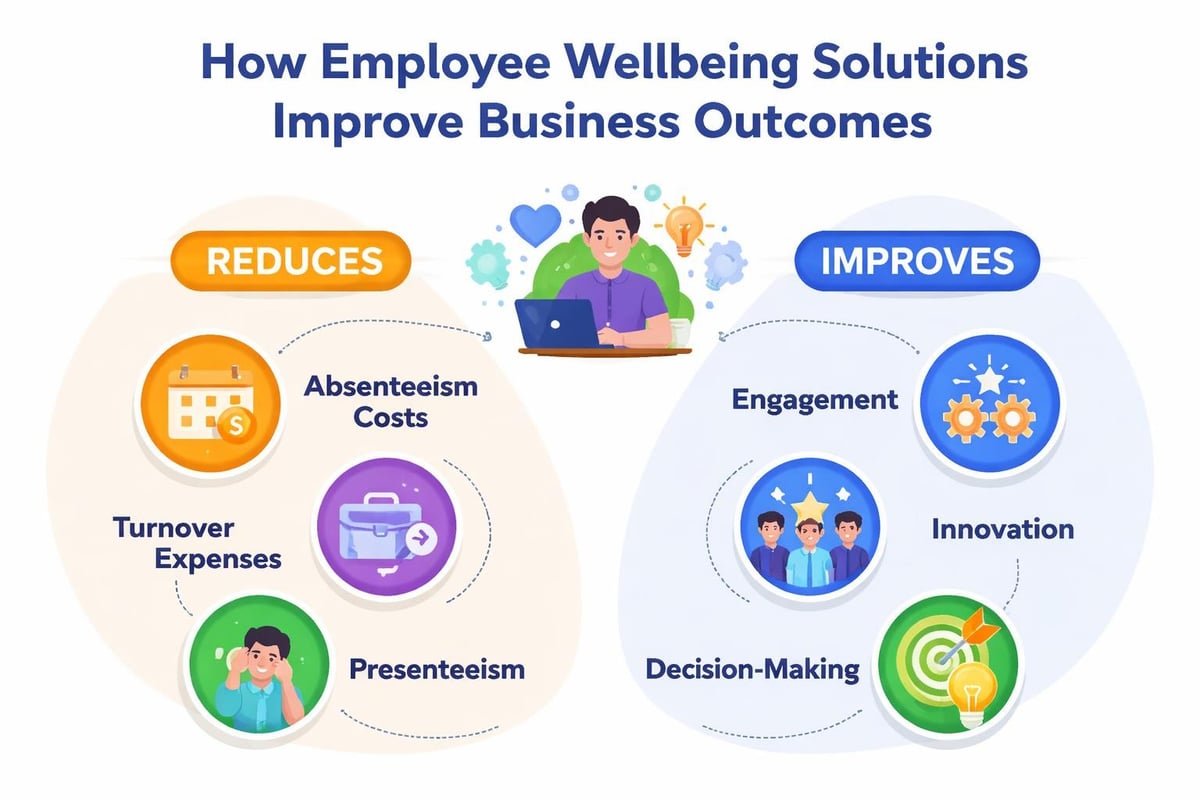
Evidence from organizations with mature workplace wellbeing strategies suggests that higher employee wellbeing is associated with stronger business and workforce outcomes, including productivity, engagement, retention, and organizational performance. These benefits may reflect factors such as improved concentration, stronger workplace relationships, better stress management, and healthier work practices. Structured mental health and wellbeing training can contribute to these outcomes when it forms part of a broader organizational approach to employee wellbeing.
Assessment and Diagnostic Frameworks
Implementing effective employee wellbeing solutions begins with accurate assessment of current state conditions. Organizations cannot address needs they have not measured or understood through systematic data collection.
Workplace wellbeing assessments serve multiple functions beyond baseline measurement. They identify specific risk factors, reveal demographic variations in wellbeing levels, and highlight organizational strengths upon which to build. Comprehensive assessments examine individual experiences, team dynamics, and systemic factors that shape workplace mental health.
| Assessment Component | Purpose | Measurement Frequency |
|---|---|---|
| Individual stress and resilience levels | Identify support needs and track personal wellbeing trends | Quarterly |
| Team psychological safety | Evaluate interpersonal dynamics and collaboration quality | Biannually |
| Manager mental health literacy | Assess leadership capability and training effectiveness | Annually |
| Organizational culture indicators | Measure systemic factors affecting wellbeing | Annually |
| Absenteeism and presenteeism data | Track performance outcomes and program ROI | Monthly |
Organizations should design assessment processes that protect confidentiality while generating actionable insights. Aggregated reporting at team and department levels reveals patterns without exposing individual responses. This approach maintains trust while enabling targeted interventions where needs are greatest.
Interpreting Assessment Data for Strategy Development
Raw data requires thoughtful interpretation to inform employee wellbeing solutions. Comparing results across demographic groups, departments, and organizational levels identifies where concentrated effort yields maximum impact. Statistical analysis reveals whether observed differences represent meaningful variations requiring distinct approaches or normal fluctuation within acceptable ranges.
Effective interpretation connects quantitative metrics with qualitative insights gathered through focus groups and manager feedback. Numbers indicate where problems exist, while narratives explain why those problems persist and what barriers prevent improvement. This combination informs realistic implementation planning that accounts for organizational context rather than applying generic templates.
Manager Training as Foundation for Wellbeing Solutions
Leadership capability represents the most critical variable determining whether employee wellbeing solutions succeed or fail. Managers directly influence team dynamics, workload distribution, psychological safety, and access to support resources. Without equipped managers, even well-designed programs produce disappointing results.
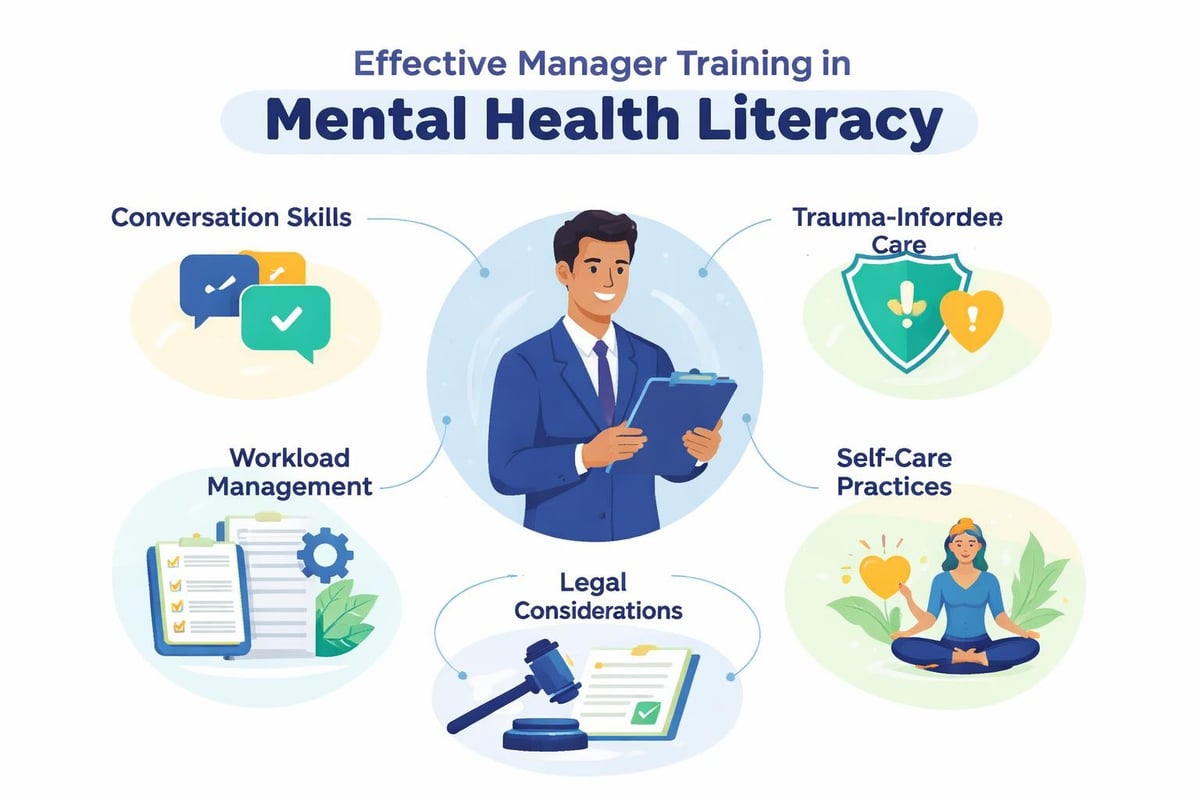
Mental health literacy training for managers builds practical skills rather than theoretical knowledge. Effective programs teach recognition of early warning signs, appropriate response strategies, and clear pathways for connecting employees with professional resources. This approach empowers managers to act confidently while maintaining appropriate boundaries between managerial support and clinical treatment.
Training curricula should address:
- Conversation frameworks for discussing mental health concerns without diagnostic language
- Trauma-informed approaches that recognize how past experiences shape current responses
- Workload management strategies that prevent chronic stress from escalating into burnout
- Self-care practices that maintain manager wellbeing while supporting teams
- Legal and ethical considerations governing workplace mental health interventions
Building Sustainable Manager Capability
Single training sessions rarely produce lasting behavior change. Sustainable employee wellbeing solutions incorporate ongoing manager development through refresher training, peer learning communities, and coaching support. Leadership approaches that prioritize employee wellbeing require practice and reinforcement over time.
Organizations should establish clear expectations that managers will apply learned skills and create accountability mechanisms that track implementation. Regular check-ins between senior leaders and frontline managers reveal where additional support is needed and celebrate progress toward wellbeing objectives.
Resilience Programs for Employee Populations
While manager capability provides essential infrastructure, direct employee programming addresses individual skill development. Resilience training equips workers with practical strategies for managing stress, recovering from setbacks, and maintaining psychological wellbeing amid workplace demands.
Effective resilience programs differ from generic stress management workshops. They build specific competencies including cognitive flexibility, emotional regulation, problem-solving under pressure, and social connection. These capabilities enable employees to navigate challenges without experiencing chronic strain that degrades mental health over time.
Program design should accommodate different learning preferences and engagement levels:
- Self-paced digital learning modules for employees who prefer independent study
- Interactive workshops that build skills through group practice and discussion
- Microlearning resources delivering brief, focused content during workflow
- Coaching or mentoring relationships providing personalized guidance and accountability
- Peer support networks creating communities for shared learning and mutual encouragement
Measuring Resilience Program Effectiveness
Organizations must establish clear metrics that indicate whether resilience training produces intended outcomes. Self-reported skill confidence provides one data point, while behavioral indicators including reduced sick leave, improved performance ratings, and decreased conflict incidents offer objective evidence.
Longitudinal tracking reveals whether initial gains persist over time or fade without reinforcement. Programs that integrate resilience concepts into daily operations through manager reinforcement and cultural messaging typically demonstrate more sustainable results than standalone initiatives.
Trauma-Informed Care Training
Many employees enter workplaces carrying effects of previous traumatic experiences. Trauma-informed employee wellbeing solutions recognize this reality and create environments that promote healing rather than inadvertently re-traumatizing individuals.
Trauma-informed care training teaches organizational members to understand how trauma affects behavior, thinking, and relationships. This knowledge prevents misinterpretation of trauma responses as performance problems or interpersonal conflicts. Staff learn to respond with appropriate support rather than disciplinary action when trauma-related difficulties emerge.
| Trauma-Informed Principle | Workplace Application | Expected Outcome |
|---|---|---|
| Safety | Create predictable processes and clear communication | Reduced anxiety and hypervigilance |
| Trustworthiness | Follow through on commitments and explain decisions | Improved engagement and openness |
| Peer support | Foster connection and reduce isolation | Enhanced team cohesion and mutual aid |
| Collaboration | Involve employees in decisions affecting them | Greater autonomy and empowerment |
| Empowerment | Build on strengths rather than focus on deficits | Increased confidence and capability |
Organizations implementing trauma-informed approaches report improved employee retention, particularly among populations with higher trauma exposure. These frameworks complement rather than replace other employee wellbeing solutions by creating foundational safety that enables individuals to benefit from skill-building programs.
Strategic Consultation and Implementation Support
Many organizations recognize the need for comprehensive employee wellbeing solutions but lack internal expertise to design and implement effective programs. Strategic consultation provides specialized knowledge that accelerates progress while avoiding common implementation pitfalls.
Consultants bring cross-organizational perspective on what approaches work across different industries, workforce compositions, and organizational cultures. This experience prevents organizations from investing resources in interventions unlikely to succeed given their specific context.
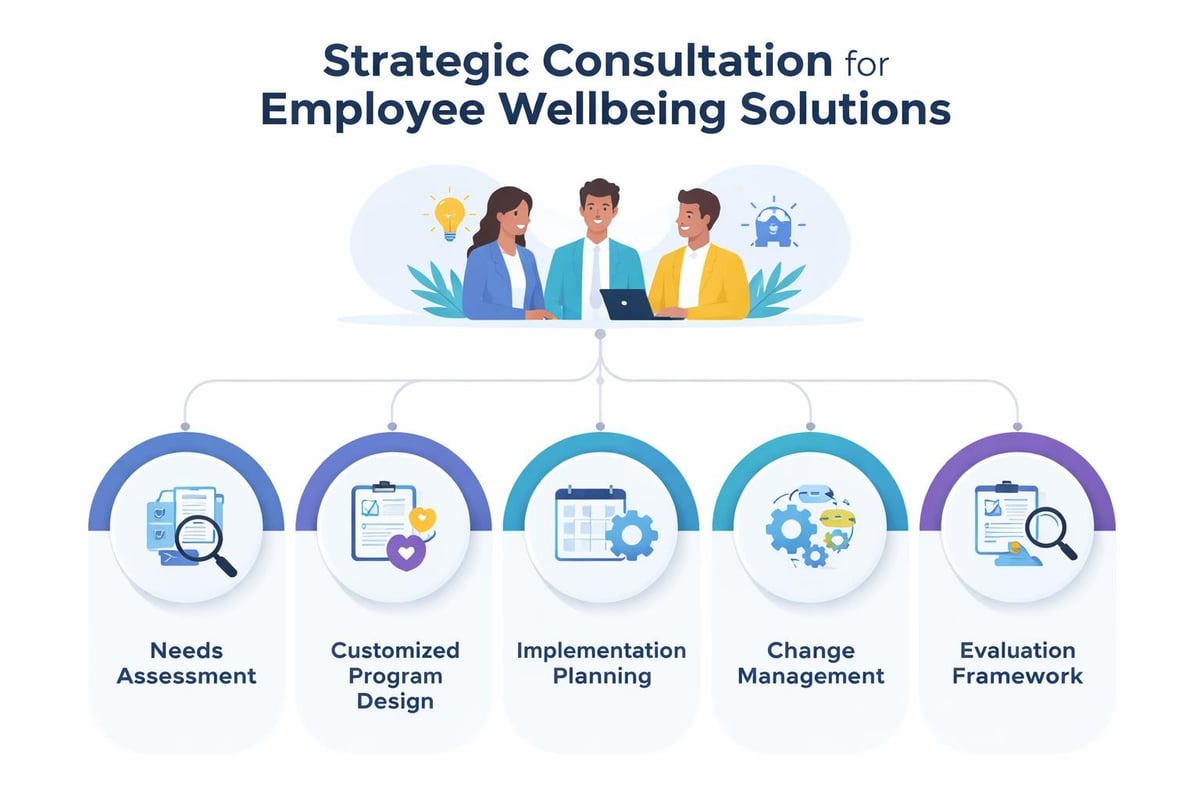
Effective consultation relationships involve:
- Needs assessment and gap analysis identifying current state and desired outcomes
- Program design creating customized solutions rather than generic packages
- Implementation planning establishing realistic timelines and resource requirements
- Change management support addressing resistance and building stakeholder buy-in
- Evaluation framework development defining success metrics and measurement processes
Building Internal Capacity
While external expertise accelerates initial implementation, sustainable employee wellbeing solutions require developing internal organizational capability. Consultation should include knowledge transfer that enables staff to maintain and evolve programs without ongoing external dependence.
Organizations benefit from designating internal champions who coordinate wellbeing initiatives, track outcomes, and advocate for continued investment. These individuals gain expertise through consultant partnerships and eventually assume primary responsibility for program management.
Integration with Existing Workplace Systems
Employee wellbeing solutions achieve maximum impact when integrated into existing operational systems rather than operating as parallel initiatives. Performance management, professional development, onboarding, and workplace safety all offer opportunities to embed wellbeing concepts into standard practice.
Performance conversations should address workload sustainability alongside productivity metrics. Development planning can incorporate resilience skill building as core competency development. Onboarding processes introduce wellbeing resources and establish expectations that mental health matters from day one.
Safety systems provide particularly valuable integration points. Psychological safety deserves equal attention to physical safety, with similar incident reporting, investigation, and prevention processes. Organizations that treat mental health injuries with the same seriousness as physical injuries demonstrate authentic commitment to comprehensive wellbeing.
Specialized Populations and Targeted Interventions
While universal programs benefit entire workforces, some populations face unique challenges requiring targeted employee wellbeing solutions. Frontline workers, remote employees, shift workers, and client-facing staff encounter distinct stressors that generic interventions may not adequately address.
Narrative reviews of employee wellbeing resources for governmental public health professionals demonstrate the value of occupation-specific approaches. Public health workers face secondary traumatic stress from exposure to community suffering, requiring interventions that address compassion fatigue and moral distress.
Organizations should analyze wellbeing data by employee segment to identify where targeted interventions complement universal programming. Resource allocation becomes more efficient when concentrated where needs are greatest rather than distributed equally regardless of actual requirements.
Engaging Hard-to-Reach Employees
Some workforce segments consistently show lower engagement with wellbeing programs despite potentially higher need. Shift workers, remote employees, and certain demographic groups require modified delivery approaches that remove participation barriers.
Successful strategies include:
- Offering programs during multiple time slots to accommodate varying schedules
- Providing digital access for remote workers with limited in-person availability
- Delivering content in multiple languages for diverse workforces
- Partnering with trusted community organizations that already serve specific populations
- Creating peer-led initiatives that feel culturally relevant rather than organizationally imposed
Effective workplace wellbeing initiatives recognize that employees have diverse needs, experiences, and barriers to accessing support. Tailoring programs to different workforce groups, workplace contexts, and individual circumstances can make wellbeing initiatives more relevant, inclusive, and effective than a one-size-fits-all approach.
Building Organizational Resilience Through Strengths-Based Approaches
While problem-focused interventions can help organizations identify and address risks, strengths-based approaches focus on the capabilities, resources, and protective factors that already exist within a workplace. Building on these strengths can help foster engagement, resilience, and a stronger sense of collective capability.
Rather than focusing exclusively on what is not working, organizations can identify existing protective factors — such as supportive relationships, effective leadership practices, employee strengths, and positive workplace connections — and consider how these can be reinforced and extended across the organization.
This keeps the strengths-based concept while avoiding an unsupported claim that one approach is inherently better than another.
Strengths-based assessment identifies:
- Teams demonstrating high psychological safety whose practices can be modeled elsewhere
- Managers effectively supporting employee mental health who can mentor peers
- Informal support networks that already provide peer assistance
- Cultural traditions that promote connection and belonging
- Existing policies and practices that protect wellbeing
This inventory informs strategy that scales what works rather than importing entirely new systems that may clash with organizational culture.
Technology-Enabled Wellbeing Solutions
Digital platforms expand access to employee wellbeing solutions while reducing delivery costs. Apps, online learning portals, telehealth services, and data analytics tools enable personalized support at scale.
Technology works best when complementing rather than replacing human interaction. Digital mental health assessments can screen for risk and connect individuals with appropriate resources. Online resilience training provides flexible learning options, while in-person manager support offers the relational connection that many employees need during difficult periods.
| Technology Type | Primary Function | Best Use Case |
|---|---|---|
| Mental health apps | Self-guided skill practice and mood tracking | Maintaining wellbeing between higher-intensity interventions |
| Telehealth platforms | Remote access to counseling and psychiatric services | Serving geographically dispersed or mobility-limited employees |
| Learning management systems | Delivering structured training at scale | Building universal mental health literacy across large workforces |
| Analytics dashboards | Tracking program engagement and outcomes | Demonstrating ROI and identifying improvement opportunities |
| Communication platforms | Sharing resources and fostering peer connection | Reducing isolation and normalizing mental health conversations |
Organizations should evaluate technology solutions against clear criteria including evidence base, data security, accessibility standards, and integration capability with existing systems. Vendor claims require verification through pilot testing and outcome measurement rather than acceptance at face value.
Cultural Change and Sustainable Implementation
Employee wellbeing solutions ultimately fail or succeed based on cultural factors more than program design quality. Organizations with cultures that stigmatize mental health struggle to achieve participation regardless of how well-designed their offerings may be.
Cultural change requires persistent effort across multiple levels. Senior leaders must visibly prioritize wellbeing through resource allocation, policy decisions, and personal example. Middle managers translate priorities into daily practice through how they structure work, respond to struggles, and model healthy boundaries. Employees reinforce culture through peer interactions and willingness to access available support.
Effective cultural change strategies include:
- Leadership storytelling that normalizes mental health challenges and help-seeking
- Policy alignment ensuring performance expectations don’t contradict wellbeing goals
- Recognition systems that celebrate wellbeing outcomes alongside traditional metrics
- Environmental design creating physical spaces that support restoration and connection
- Continuous communication keeping wellbeing visible rather than limiting discussion to awareness weeks
Organizations should expect cultural transformation to require three to five years of sustained effort. Early wins build momentum, but lasting change emerges through repeated reinforcement that wellbeing genuinely matters to organizational success.
Measurement, Evaluation, and Continuous Improvement
Rigorous evaluation separates effective employee wellbeing solutions from feel-good initiatives that consume resources without producing results. Organizations need clear frameworks that track both process measures and outcome indicators.
Process measures assess implementation quality:
- Participation rates across different programs and populations
- Manager completion of mental health literacy training
- Employee awareness of available resources
- Satisfaction ratings for specific interventions
Outcome measures evaluate actual impact:
- Absenteeism rates and sick leave utilization
- Presenteeism indicators including concentration and work quality
- Employee engagement and retention metrics
- Performance ratings and productivity measures
- Healthcare cost trends and disability claim frequency
Sophisticated organizations track leading indicators that predict future outcomes rather than relying solely on lagging measures. Early warning signs including increased stress levels or declining psychological safety allow proactive intervention before problems escalate into costly consequences.
Creating Feedback Loops
Measurement data should inform continuous program improvement rather than serving only accountability purposes. Regular review cycles examine what’s working well and what requires adjustment based on actual evidence rather than assumptions.
Feedback mechanisms should capture employee and manager perspectives on program relevance, accessibility, and effectiveness. Anonymous surveys, focus groups, and usage analytics all contribute insights that shape program evolution. Organizations committed to excellence view their wellbeing solutions as perpetually in beta, always learning and adapting based on new information.
Making employee wellbeing a strategic priority requires this commitment to evidence-based refinement rather than implementing programs and assuming they’ll remain effective indefinitely regardless of changing workforce needs or environmental conditions.
Strategic employee wellbeing solutions deliver measurable benefits when organizations move beyond superficial programming to comprehensive, culturally embedded systems that equip managers, build employee capabilities, and create psychologically safe environments. The most successful approaches combine universal mental health literacy with targeted interventions for specific populations, all grounded in rigorous assessment and continuous improvement. Workplace Mental Health Institute provides the specialized training, assessment tools, and strategic consultation that organizations need to implement evidence-based wellbeing solutions that reduce absenteeism, improve performance, and create genuinely supportive workplace cultures where people can thrive professionally and personally.

