
Organizations spend billions annually on mental health training for managers, yet the majority of those programs produce no measurable change in manager behavior, team psychological safety, or employee wellbeing outcomes. According to McKinsey, poor mental health costs the global economy approximately $1 trillion per year in lost productivity, yet most corporate training responses amount to a half-day workshop and a wellness app subscription. That gap between investment and outcome is not a budget problem. It is a design problem. This article breaks down exactly why conventional approaches fail and what high-performing organizations do differently.
Table of Contents
- Quick Takeaways
- Why Conventional Manager Mental Health Training Fails
- The Competency Gap Nobody Talks About
- What High-Performing Organizations Do Instead
- Resilience Skills for Managers: Beyond the Buzzword
- Building Workplace Psychological Safety at the Team Level
- Comparing Approaches to Manager Mental Health Training
- Adaptability Skills for Managers: The Missing Link
- Employee Wellbeing Strategy That Actually Changes Behavior
- Frequently Asked Questions
- References
Quick Takeaways
| Key Insight | Explanation |
|---|---|
| One-off workshops do not change behavior | Without spaced repetition and on-the-job practice, knowledge from a single training session decays within days. High-performing organizations build multi-touchpoint learning journeys instead. |
| Awareness is not a skill | Teaching managers to recognize signs of distress is necessary but insufficient. They also need practiced, rehearsed responses and clear organizational support structures behind them. |
| Psychosocial safety must be systemic, not individual | Placing responsibility for workplace psychological safety entirely on the manager ignores the role of workload design, leadership culture, and organizational policies. |
| Resilience skills for managers require identity-level change | Managers who believe their role is to appear strong under pressure will not apply resilience tools. Training must address underlying beliefs, not just surface-level techniques. |
| Measurement is non-negotiable | Organizations that track psychological injury claims, absenteeism rates, and team engagement scores before and after training are the ones that can demonstrate and sustain ROI. |
| Manager mental health training must connect to business metrics | HR leaders who frame mental health investment in terms of reduced claims, turnover costs, and productivity gain secure ongoing organizational commitment far more effectively. |
| Adaptability skills for managers predict team mental health outcomes | Research consistently shows that a manager’s ability to regulate their own stress and adapt their approach under pressure is one of the strongest predictors of direct-report wellbeing. |
Why Conventional Manager Mental Health Training Fails
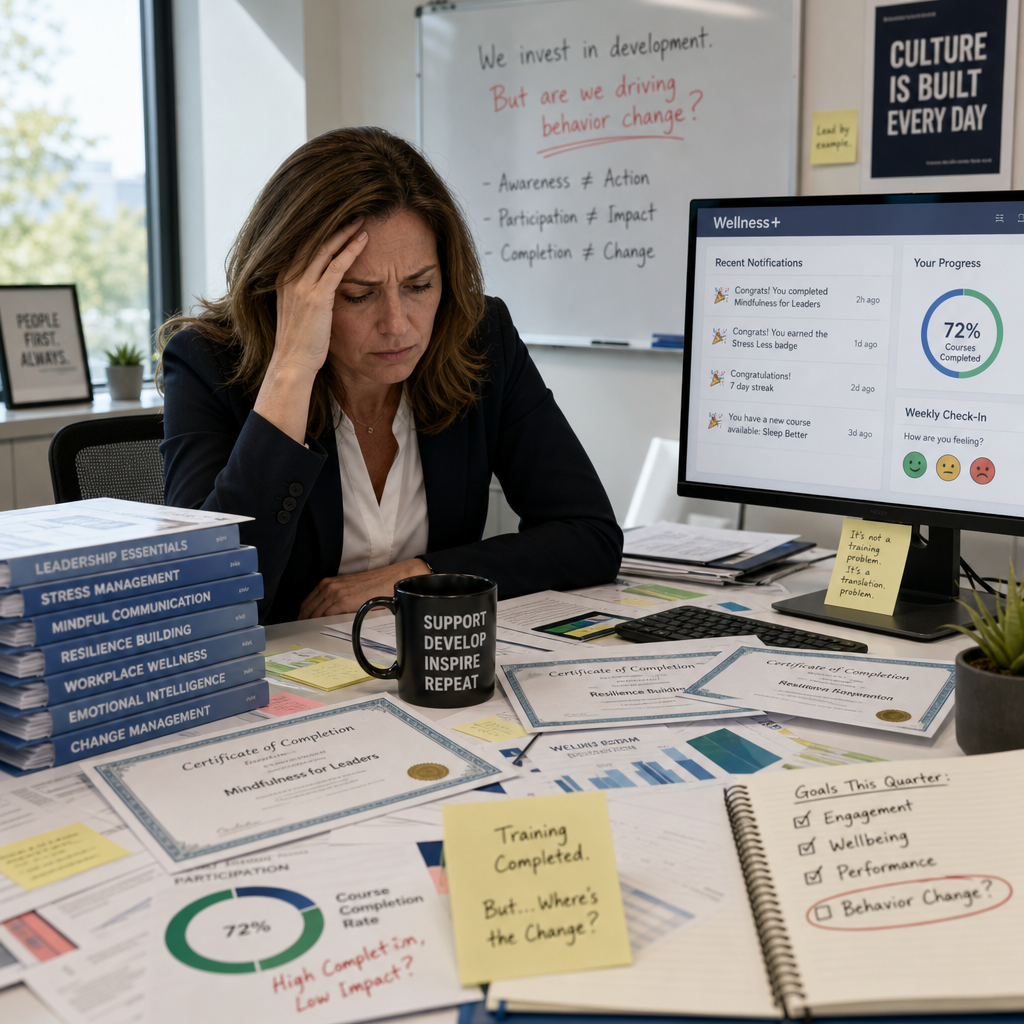
The most common format for manager mental health training is a half-day session, sometimes delivered by a clinical psychologist, more often by a general facilitator with a slide deck about the five signs of burnout. Managers complete a quiz, receive a certificate, and return to a workload that has not changed at all. The training treats mental health as a knowledge problem when it is actually a skill and systems problem.
A common mistake is assuming that increasing awareness automatically produces behavior change. It does not. Managers who know what depression looks like in a team member still avoid the conversation because they lack practiced language, fear saying the wrong thing, or have never seen their own leadership model that kind of dialogue. Awareness without rehearsed application is an expensive way to do nothing.
The data consistently shows this. A 2021 report from the World Health Organization found that for every $1 invested in mental health treatment and support, there is a return of $4 in improved health and productivity. But that return requires effective intervention design. Organizations that invest in one-off awareness training are not accessing that return. They are paying for the appearance of action without the outcomes.
There is also a structural problem. Most training programs place the entire burden of employee mental health on the individual manager, without addressing workload demands, role clarity, or the psychological safety of the broader organizational culture. Managers cannot hold psychological space for their teams while simultaneously being overwhelmed and under-supported themselves.
The Competency Gap Nobody Talks About
High-performing organizations differentiate between mental health literacy and mental health skills for managers. Literacy means understanding concepts. Skills mean being able to act under pressure, in real time, with a real person in front of you. Those are fundamentally different capabilities and they require fundamentally different training approaches.
What Mental Health Skills for Managers Actually Look Like
In practice, a manager with genuine mental health skills can notice when a high performer’s output pattern changes and name it without pathologizing it. They can hold a check-in conversation that does not feel clinical or transactional. They can redirect a team member toward professional support without shame or stigma. They can regulate their own emotional responses when a conversation becomes distressing. None of these capabilities emerge from a slide deck.
These skills develop through structured practice, feedback, and repetition. Role-play and scenario-based learning, despite being uncomfortable for many managers, are among the most evidence-supported methods for building these capabilities. Programs designed by organizational psychologists, rather than HR generalists, tend to build these skills more reliably because they are grounded in behavior change science rather than content delivery logic.
Why Role and Identity Beliefs Block Application
A manager who has internalized the belief that emotional disclosure is weakness will not use the skills from any training, regardless of quality. This is one of the most underexamined barriers in the field. Effective mental health training for managers must include work on the manager’s own relationship with vulnerability, stress, and self-disclosure. Without this, the training produces knowledge that never gets applied because it conflicts with the manager’s self-concept.
This is not soft. It is evidence-based. Amy Edmondson’s research at Harvard Business School on psychological safety consistently points to leader behavior as the primary driver of team-level safety. Leader behavior is shaped by leader beliefs. Training that ignores beliefs addresses only the surface layer of the problem.
“The most important thing a manager can do to create a psychologically safe climate is to model fallibility. When leaders ask for feedback and acknowledge their own limitations, they signal that it is safe for others to do the same.” — Amy Edmondson, Harvard Business School
What High-Performing Organizations Do Instead
Organizations that achieve measurable reductions in absenteeism, psychological injury claims, and presenteeism through their mental health programs share several structural features. None of them involve a one-time event. All of them involve sustained, systemic design.
They Start with a Workplace Assessment
Before any training is delivered, high-performing organizations conduct a proper assessment of their psychosocial risk landscape. This means examining workload demands, role clarity, control and autonomy, interpersonal conflict rates, and existing psychological safety indicators. Training designed without this diagnostic data is essentially guesswork dressed as strategy.
A structured workplace assessment also creates a baseline for measurement. Without a baseline, organizations cannot demonstrate whether their investment in manager development is producing any return at all. This is a critical point for HR leaders who need to justify ongoing budget allocation to executive teams.
They Treat Training as a System, Not an Event
The organizations consistently achieving results build multi-stage learning programs. An initial skills-based training is followed by peer learning groups, structured reflection processes, and coaching touchpoints spaced over three to six months. Spaced repetition and social reinforcement are the mechanisms that convert training content into durable behavior change. A single workshop cannot do this, regardless of how well it is designed.
WMHI’s approach to manager development exemplifies this. Rather than delivering a standalone course, psychologist-led programs are embedded within broader organizational development contexts that include leader training, employee programs, and psychosocial safety frameworks that reinforce learning at multiple organizational levels.
Pro tip: If your current manager mental health program does not include at least three post-training practice touchpoints spread over 90 days, the behavior change rate will be close to zero regardless of training quality. Build the follow-through into the program design, not as an afterthought.
Resilience Skills for Managers: Beyond the Buzzword
Resilience has become one of the most overused and poorly defined concepts in workplace mental health. Most training programs treat it as an individual trait, something a person either has or develops through inspirational content. This framing is both scientifically inaccurate and organizationally harmful because it implicitly places the burden of psychological survival entirely on the employee.
Resilience skills for managers are specific, teachable behavioral competencies, not personality traits. They include cognitive reappraisal under pressure, behavioral flexibility when plans fail, the ability to seek and integrate support without perceived status loss, and the capacity to maintain decision quality during sustained uncertainty. These are learnable. They are also measurable.
Why Manager Resilience Directly Predicts Team Outcomes
Research published in the Journal of Occupational Health Psychology consistently links manager stress-regulation capacity to direct-report burnout rates. Managers who dysregulate under pressure, express unpredictable emotional responses, or withdraw from their teams during high-demand periods create the conditions for team-level psychological injury. The reverse is also true. Managers who model adaptive coping create a contagion effect of regulated, functional stress responses in their teams.
This means that building resilience skills in managers is not just about the managers themselves. It is a team-level intervention. Organizations that frame manager resilience development this way tend to secure stronger executive buy-in because the logic connects directly to team performance and retention metrics that leadership already cares about.

Building Workplace Psychological Safety at the Team Level
Workplace psychological safety is not a feeling. It is a measurable team climate characterized by the shared belief that it is safe to take interpersonal risks, including speaking up, asking questions, admitting errors, and raising concerns without fear of punishment or humiliation. Amy Edmondson’s research across dozens of industries has demonstrated that psychological safety is the single strongest predictor of team learning behavior and one of the most consistent predictors of team performance.
The mistake most organizations make is treating psychological safety as a values statement rather than a behavioral practice. Posting values on the wall does not create safety. Manager behavior creates safety, and manager behavior is shaped by training, modeling, incentives, and organizational norms.
Specific Manager Behaviors That Build or Destroy Team Safety
In practice, psychological safety is built through small, repeated behaviors: asking for input before sharing your own view, responding to errors with curiosity rather than blame, explicitly inviting dissenting opinions during planning discussions, and following up on mental health conversations in a way that feels supportive rather than surveillance-like. These behaviors can be trained, practiced, and measured.
Conversely, psychological safety is destroyed by specific behaviors: publicly criticizing team members for failures, ignoring raised concerns, demonstrating visible favoritism, and inconsistency between stated values and actual decisions. Many managers engage in safety-destroying behaviors without awareness, which is precisely why psychologist-led training that includes behavioral observation and feedback is more effective than self-directed learning modules.
Pro tip: The fastest way to assess psychological safety in a team is to ask this question in a confidential survey: “If you made a mistake in this team, what would happen?” The variance in answers, not just the average, tells you more about the actual safety climate than any engagement score.
Comparing Approaches to Manager Mental Health Training
| Approach | What It Delivers | Where It Falls Short |
|---|---|---|
| Mental Health First Aid (MHFA) Training | Broad awareness of mental health conditions, basic conversation skills, signposting to professional resources. Widely recognized and relatively affordable to deliver at scale. | Does not build the systemic skills required for sustained manager behavior change. No organizational-level psychosocial safety component. Awareness without supported application rarely changes practice. |
| Psychologist-Led Organizational Programs (e.g., WMHI’s approach) | Skills-based training grounded in behavior change science, integrated with workplace assessment, psychosocial safety frameworks, and multi-stage learning design. Addresses both manager capability and organizational systems simultaneously. | Requires greater organizational commitment and investment. Results depend on executive sponsorship and willingness to address systemic contributors to psychological risk, not just individual manager behavior. |
| EAP-Linked Manager Awareness Modules | Convenient, often self-paced content that introduces key mental health concepts. Easy to deploy across large manager populations. Typically bundled with employee assistance program access. | Self-paced modules without facilitated practice produce very low skill transfer rates. No accountability mechanism, no cohort learning, and no connection to team-level psychological safety outcomes. |
Adaptability Skills for Managers: The Missing Link
Most employee wellbeing strategies focus on what managers should know and say. Very few address what managers should be able to do when circumstances change rapidly, when team dynamics shift, or when their own mental health is under strain. This is the gap that adaptability skills for managers directly address.
Adaptability in this context means behavioral flexibility under pressure. It means being able to shift from a directive style to a supportive style within the same conversation based on what the team member actually needs. It means recognizing when your default leadership approach is not working and having an alternative approach ready to deploy. It means maintaining relational connection with your team even during periods of high personal stress.
Why Adaptability Predicts Mental Health Outcomes More Reliably Than Empathy Training
Empathy training has become enormously popular in corporate wellness contexts. The problem is that empathy without behavioral flexibility is limited in its practical value. A manager can feel genuine empathy for a distressed team member and still respond in a way that makes the situation worse, either by over-responding with emotional intensity that escalates the team member’s distress, or under-responding with clinical detachment that communicates the issue is not important.
Adaptability training teaches managers to read the situational needs of a conversation and adjust their response accordingly. This skill, sometimes described in organizational psychology as situational coaching capability, is consistently associated with better team mental health outcomes in the research literature. Organizations that include adaptability development in their manager training programs alongside conventional mental health awareness content see meaningfully better results than those that deliver either in isolation.

Employee Wellbeing Strategy That Actually Changes Behavior
An employee wellbeing strategy that produces measurable results looks very different from the typical annual survey plus wellness challenge plus EAP reminder approach that most organizations default to. The difference between performative wellbeing and effective wellbeing strategy is organizational willingness to examine and address the structural contributors to psychological risk.
High-performing organizations build wellbeing strategies around the following components: a psychosocial risk assessment that identifies actual organizational stressors, targeted manager capability development based on that assessment, systems-level changes to workload design and role clarity, trauma-informed approaches for industries with high exposure to vicarious trauma, and measurement frameworks that connect wellbeing initiatives to business outcomes.
The Role of Trauma-Informed Practice in Organizational Settings
Most manager training programs ignore the reality that a significant proportion of the workforce has experienced trauma that shapes their responses to workplace stress, authority relationships, and high-pressure situations. Trauma-informed organizational practice does not mean every manager becomes a trauma therapist. It means that leaders understand how trauma influences behavior, avoid inadvertently re-traumatizing team members through management practices, and create environments where people feel safe enough to do their best work.
WMHI’s trauma-informed care programs for organizations address this directly, embedding trauma-aware principles into manager development and organizational design rather than treating it as a clinical specialty disconnected from everyday leadership practice.
Measuring What Matters: From Lagging to Leading Indicators
The organizations that sustain investment in mental health programs are those that measure leading indicators, not just lagging ones. Lagging indicators include absenteeism rates, psychological injury claims, and turnover. These matter, but they tell you what already went wrong. Leading indicators include team-level psychological safety scores, manager behavior self-assessment and 360-degree feedback, and employee confidence in raising concerns with their manager. Organizations that track both types of data can intervene earlier and demonstrate program impact more convincingly to executive stakeholders.
Frequently Asked Questions
What is the most important factor in making manager mental health training effective?
The single most important factor is sustained behavioral practice after the initial training. Knowledge transfer without repeated application under realistic conditions produces minimal behavior change. Organizations that build in structured post-training practice, peer learning, and accountability mechanisms see significantly better outcomes than those that treat training as a one-time event.
How long should a manager mental health training program run?
Effective programs are designed across a minimum of three to six months. The initial skills-based component may run one to two days, but the learning architecture should include spaced practice sessions, group reflection, and individual coaching touchpoints across that timeframe. Any program shorter than this is unlikely to produce durable behavior change at the manager level.
Should mental health training for managers be delivered by psychologists or trained HR professionals?
For programs designed to produce skill-level change and address psychosocial safety at an organizational level, psychologist-led delivery is substantially more effective. HR professionals can play an important role in program coordination and cultural reinforcement, but the clinical and behavioral science expertise required to design and facilitate skills-based mental health training is a specialized capability that general HR training does not provide.
How do we build a business case for investing in manager mental health skills development?
The most compelling business case connects training investment to costs that finance and executive leadership already measure. These include the cost per psychological injury claim, the cost of replacing a team member who leaves due to burnout, and the productivity cost of presenteeism. McKinsey research suggests that absenteeism and presenteeism combined can represent 3 to 4 percent of total payroll costs for organizations that are not actively managing psychosocial risk. Framing training investment against that baseline makes the ROI conversation straightforward.
What is the difference between psychosocial safety and psychological safety?
Psychological safety, as defined by Amy Edmondson, is a team-level climate construct describing whether team members feel safe taking interpersonal risks. Psychosocial safety is a broader organizational construct that encompasses the systems, policies, and organizational conditions that protect worker mental health, as defined by the psychosocial safety climate framework developed by Professor Maureen Dollard. Both are relevant to effective manager training, but psychosocial safety operates at the organizational level and requires systems-level change, not just manager behavior change.
Can resilience training actually reduce psychological injury claims?
Yes, but only when resilience training is part of a comprehensive approach that also addresses organizational stressors. Resilience training in isolation, delivered to employees without addressing the structural causes of workplace stress, can actually increase psychological harm by implying that employees should simply cope better with unreasonable demands. When resilience skills development is combined with systemic psychosocial risk reduction, the evidence for reduced claims and improved wellbeing is substantially stronger.
How do we know if our managers actually have mental health skills, not just awareness?
The most reliable method is behavioral assessment, specifically structured role-play or scenario-based observation scored against defined behavioral competencies. Self-reported confidence scores are unreliable because managers who have received awareness training often overestimate their competence. Direct behavioral observation by a trained assessor before and after a development program gives you accurate data on actual skill acquisition, not just perceived readiness.
If your organization has been running manager mental health training with minimal measurable results, share what has and has not worked for your team in the comments below. Your experience may be exactly what another HR leader needs to hear.
References
- McKinsey and Company research on mental health, workplace productivity, and the economic cost of untreated psychological conditions globally
- World Health Organization data on the return on investment from workplace mental health interventions and global burden of mental health conditions
- Forbes coverage of organizational psychology research on manager behavior, team psychological safety, and employee wellbeing strategy
- Statista statistics on absenteeism rates, mental health-related workplace costs, and employee assistance program utilization across industries
- Harvard Business Review research and practitioner articles on psychological safety, manager effectiveness, and evidence-based approaches to workplace wellbeing

