
How Everyday Work Pressure Can Become Chronic
A full calendar does not necessarily mean someone is overwhelmed. A demanding project does not automatically create unhealthy stress. Even working late from time to time may simply be part of getting an important job done.
The difficulty begins when pressure becomes persistent.
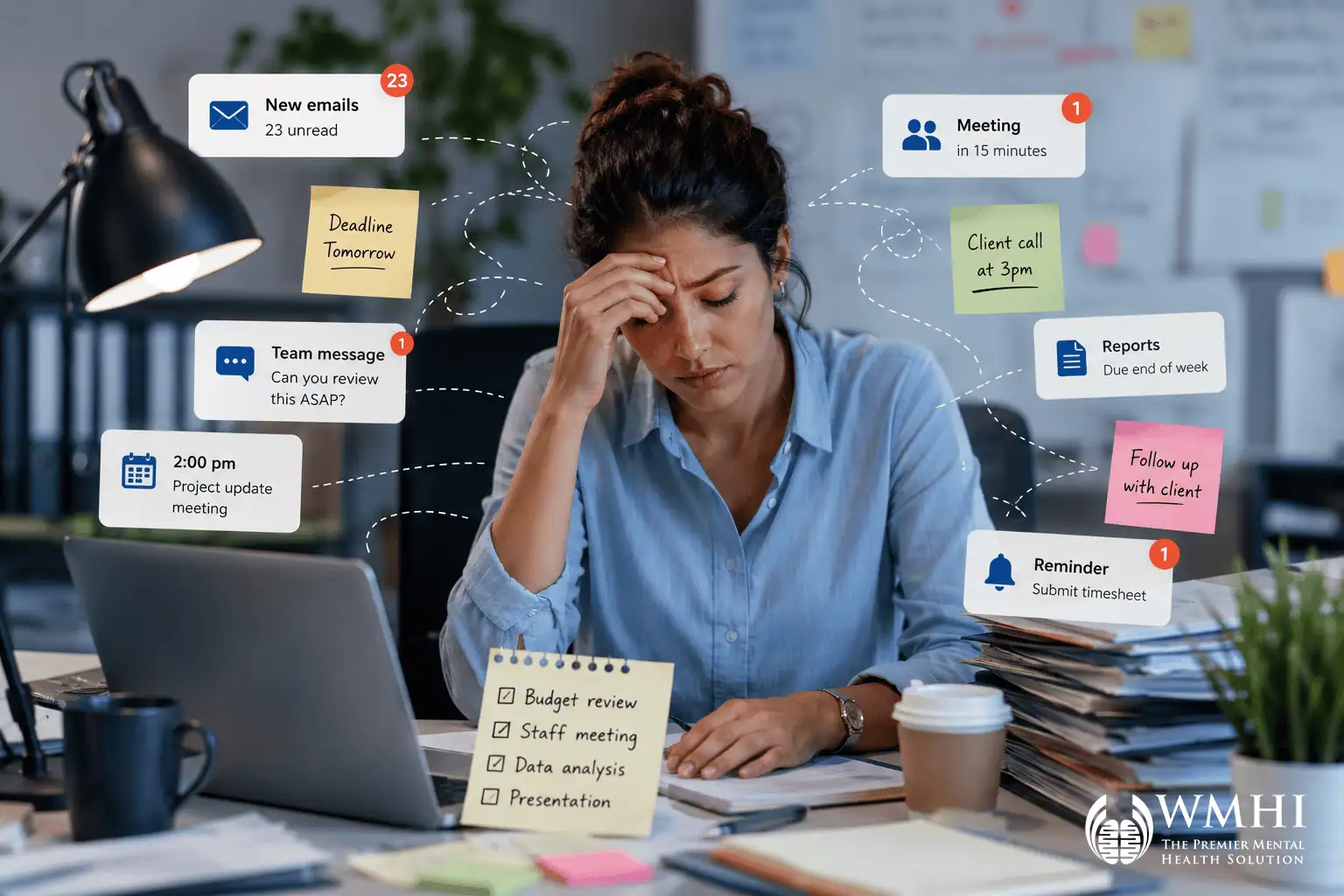
One deadline is followed by another. A meeting interrupts focused work, then another meeting takes its place. A colleague leaves and the workload is redistributed. Priorities change before the previous ones have been completed. Messages continue arriving after the working day has officially ended.
Individually, these may seem like ordinary features of modern working life.
Together, they can create something much more significant: a growing stress load that employees carry from one day to the next.
This is one of the less visible challenges in workplace mental health. Chronic work-related stress does not always begin with a major incident or an obviously unhealthy workplace. Sometimes it develops through the accumulation of ordinary pressures that never quite give people enough time, control or opportunity to recover.
The result can be a workplace where people are technically coping, but are doing so with less energy, less patience and less capacity than they had before.
For organizations, that raises an important question:
Are we looking at individual stress, or are we looking at a pattern in the way work is being experienced?
Stress Is Not Always a Bad Thing
Stress has an important place in working life.
A deadline can create focus. A challenging assignment can encourage learning. A major presentation can sharpen attention. A new responsibility can push someone to develop skills they did not previously have.
The objective of workplace mental health is therefore not to eliminate pressure.
A workplace without challenge would not necessarily be a healthy or productive workplace.
The issue is what happens when the demands placed on people become persistent and recovery becomes increasingly difficult.
A short period of intense work may be manageable when employees know what they are trying to achieve, have the resources to do it and can return to a more sustainable pace afterwards.
The same level of pressure becomes much more concerning when it continues indefinitely.
This distinction is important because chronic workplace stress is often less about one unusually difficult day and more about the pattern created by many difficult days in succession.
The Accumulation Effect
Imagine an employee begins the week with a full workload.
On Monday, a new priority is added.
On Tuesday, a colleague asks for help.
On Wednesday, a deadline moves forward.
On Thursday, an unexpected client problem requires attention.
On Friday, several unfinished tasks remain.
None of these events is necessarily unreasonable.
But the employee has spent the entire week responding to additional demands without removing anything from the original workload.
The following Monday begins with the unfinished work from the previous week, plus the new priorities that have already arrived.
This is how pressure can accumulate.
The problem is not necessarily that any individual request is excessive. It is that new demands keep being added without sufficient capacity being created elsewhere.
Over time, employees may compensate by working faster, working longer, skipping breaks, taking work home or simply accepting that some tasks will never receive the attention they deserve.
That may keep the system functioning for a while.
It does not necessarily make the system sustainable.
The “One More Thing” Problem
Most workplaces have a version of the phrase:
“Can you just…”
Can you just take a look at this?
Can you just join this meeting?
Can you just help with this client?
Can you just get this finished today?
Can you just respond before you log off?
The individual requests may be reasonable.
The problem is what happens when there is always another one.
A team may already have a carefully planned workload, but a steady stream of small requests can gradually consume the time that was supposed to be available for that work.
This creates an important management question:
When a new priority is added, what priority is removed?
If the answer is “nothing,” the organization may be increasing workload without realizing it.
The employee is left to solve the capacity problem personally.
They work later.
They work faster.
They postpone something else.
Or they carry unfinished work into the next day.
Eventually, the organization may see an employee who appears to be struggling with time management when the deeper issue is that the amount of work being requested has quietly exceeded the available capacity.
Workload Isn’t the Only Issue
When organizations talk about workplace stress, workload is usually one of the first things considered.
It should be.
But workload is only part of the picture.
Another important factor is work friction.
Work friction is the unnecessary difficulty involved in getting work done. It can come from unclear responsibilities, duplicated processes, excessive meetings, repeated interruptions, conflicting instructions, slow approvals, poor systems or constantly changing priorities.
Consider two employees who both have ten tasks to complete.
The first has clear priorities, uninterrupted periods of concentration, the information they need and authority to make routine decisions.
The second has the same ten tasks, but also has to attend multiple meetings, respond to constant messages, seek approval for minor decisions, deal with conflicting instructions and repeatedly switch between unrelated projects.
Their workloads are technically identical.
Their experience of work is not.
This is why reducing workplace stress is not always about reducing the number of tasks. Sometimes it is about removing the friction surrounding those tasks.
The Mental Cost of Constant Switching
Modern workplaces make it remarkably easy to move between different demands.
An employee can be writing a report while monitoring email, answering Teams messages, checking a project dashboard and receiving calendar reminders.
The technology is efficient.
The human experience can be less so.
Every interruption requires attention to move from one task to another. Returning to the original task then requires the employee to reconstruct where they were, what they were thinking about and what needs to happen next.
Multiply that process across an entire day and work can become mentally exhausting even when no individual task is particularly difficult.
This is one reason an employee can finish a day thinking:
“I’ve been busy all day. Why don’t I feel like I’ve actually accomplished anything?”
The answer may not be a lack of effort.
It may be a lack of uninterrupted attention.
Organizations should therefore consider not only how much work employees have, but also how often they are being asked to stop, switch and restart.
When Everything Becomes Urgent
Another contributor to the hidden stress load is the loss of meaningful priorities.
If everything is urgent, employees eventually stop knowing what “urgent” actually means.
A manager asks for something immediately.
A customer needs a response.
A senior executive changes direction.
A colleague needs assistance.
A new project appears.
The employee now has five priorities, all of which appear to have the same level of importance.
When priorities are unclear, employees often compensate by trying to do everything.
That can create a particularly difficult form of workplace pressure because there is no obvious way to succeed.
Finishing one task means another task is delayed.
Focusing on quality means something else takes longer.
Helping a colleague means personal work falls behind.
Leaving work on time can feel irresponsible because the list is still incomplete.
Clear prioritization is therefore more than a productivity technique.
It can reduce unnecessary psychological pressure by giving employees permission to understand what matters most—and what can wait.
The Workplace That Never Quite Switches Off
Technology has made work more flexible than ever.
For many employees, that flexibility is valuable.
But flexibility can gradually become permanent availability when expectations are unclear.
An employee may finish work at 5:30 p.m. but continue checking messages because they are worried that something important will arrive.
They may read an email without responding.
Then another message appears.
Then they start thinking about tomorrow’s meeting.
The employee may not be working another three hours, but mentally, work has never completely ended.
This is one reason boundaries matter.
The issue is not whether every organization should ban communication outside traditional hours. Some roles genuinely require flexibility, and some workplaces operate across different time zones.
The more useful question is:
Do employees know what is genuinely urgent and what can wait?
Clear expectations can make an enormous difference.
When people understand that an ordinary email does not require an immediate response, they can disconnect without worrying that they are failing to meet expectations.
High Performers Can Carry More Stress Than You Realize
One of the most interesting features of workplace stress is that it does not always look like poor performance.
Some of the people carrying the greatest stress load may be the employees who appear to be coping extremely well.
They are dependable.
They meet deadlines.
They volunteer to help.
They take responsibility.
They are the people managers turn to when something needs to be done quickly.
Because they have demonstrated that they can handle difficult situations, they may gradually receive more and more responsibility.
This creates a potential trap.
Being capable does not mean having unlimited capacity.
A high-performing employee can be operating very close to their limit while still producing excellent work.
The problem may only become visible when something unexpected happens.
A colleague takes leave. A major client problem appears. An organizational restructure begins. A new project is added. A personal challenge requires attention.
Suddenly, there is no remaining capacity to absorb the additional demand.
This is why organizations should be careful about treating consistently high performance as evidence that someone can simply take on more.
Sometimes high performance is being maintained by a level of effort that cannot continue indefinitely.
When Managers Become Part of the Stress Cycle
Managers are often under pressure themselves.
They have targets to meet, teams to support, customers to satisfy and decisions to make. They may also be dealing with competing demands from senior leadership.
As a result, workplace pressure can move through an organization.
A senior leader adds a priority.
The manager passes it to the team.
A team leader interrupts an employee.
The employee puts aside their existing work.
The new request gets completed, but another task is delayed.
This does not necessarily mean anyone has behaved badly.
It can simply be the result of a system where new priorities are continually introduced without enough consideration of existing capacity.
This is one reason manager capability is so important to workplace mental health.
Managers need to understand not only how to support employees who may be struggling, but also how everyday decisions about priorities, communication, workload and expectations affect the team.
WMHI’s mental health awareness training for managers focuses on building practical capability so managers can recognize concerns, have appropriate conversations and contribute to healthier workplace cultures.
When Employees Stop Saying Something Is Wrong
A workplace experiencing increasing pressure does not always become more vocal.
Sometimes it becomes quieter.
Employees stop saying that deadlines are unrealistic.
They stop questioning inefficient processes.
They stop asking for clarification.
They stop telling their manager that their workload is becoming difficult.
Instead, they simply try harder.
That silence can be misleading.
It may look like agreement, when it is actually resignation.
Psychological safety plays an important role here. Employees need to be able to raise concerns, ask questions and acknowledge difficulties without automatically fearing that they will be judged as incapable or uncommitted.
This does not mean managers must agree with every concern or remove every difficult demand.
It means people should have a safe enough environment to raise the issue before it becomes a larger problem.
WMHI’s article on building psychological safety in the workplace explores this broader relationship between workplace culture, communication and the ability to speak up.
Look for Patterns, Not Diagnoses
Managers should not be expected to diagnose employees.
A manager does not need to decide whether someone has anxiety, depression, burnout or another mental health condition.
Their role is different.
They can notice changes.
They can ask whether everything is okay.
They can listen without immediately trying to solve the problem.
They can explore whether work-related factors are contributing to the difficulty.
They can discuss practical workplace adjustments where appropriate.
And they can guide employees toward appropriate organizational or professional support.
This is an important distinction for workplace mental health training.
The goal is not to turn managers into therapists.
The goal is to make managers more capable of recognizing, responding and connecting people with appropriate support.
What Should Leaders Look For?
Chronic workplace stress may not announce itself clearly, but organizations can look for patterns.
For example, leaders might notice that a team is:
- Working longer hours without a corresponding improvement in results
- Experiencing increasing conflict over relatively minor issues
- Taking fewer breaks or leave days
- Becoming less willing to raise concerns
- Experiencing increasing turnover
- Making more avoidable mistakes
- Becoming less creative or collaborative
- Depending heavily on a small number of high performers
- Spending more time in meetings and less time on meaningful work
None of these signs proves that chronic stress is present.
They are signals that may justify asking better questions.
Instead of immediately asking, “Who is struggling?” leaders can also ask, “What has changed in the way this team is working?”
That shift can reveal problems that individual-focused approaches may miss.
Reducing the Stress Load Doesn’t Mean Removing All Pressure
A healthy workplace is not a workplace where employees never feel pressure.
Some pressure is unavoidable.
Some is productive.
Some is inherent to the role.
The objective is to identify unnecessary pressure and reduce it where possible.
That might mean removing a meeting that no longer serves a purpose.
It might mean clarifying who has decision-making authority.
It might mean changing a process that repeatedly creates unnecessary work.
It might mean agreeing that not every email requires an immediate response.
It might mean reviewing whether one employee has gradually accumulated responsibilities that should be distributed across a team.
It might mean making priorities clearer when everything seems urgent.
Small organizational changes can sometimes have a surprisingly large effect because they remove repeated sources of friction.
Where Workplace Mental Health Training Fits
Training is not a substitute for good work design.
If employees are consistently overloaded because of inadequate resources, no resilience workshop can make an unrealistic workload disappear.
If priorities are constantly changing, teaching employees stress-management techniques does not solve the underlying communication problem.
If managers lack confidence discussing mental health, however, training can make a meaningful difference.
Effective workplace mental health training can help organizations build a shared understanding of mental health, reduce stigma, improve manager confidence, strengthen supportive conversations and help employees recognize when additional support may be appropriate.
It can also help leaders understand the relationship between individual wellbeing and the environment in which people work.
WMHI’s workplace mental health training is designed around this broader capability, with programs for employees, managers and leaders covering mental health awareness, resilience, leadership and workplace wellbeing.
Resilience Should Build Capacity, Not Absorb Endless Pressure
Resilience is an important part of workplace mental health.
People need skills for dealing with change, uncertainty, difficult situations and periods of increased demand.
But resilience should not be interpreted as the ability to tolerate unlimited pressure.
If an organization continually increases demands and responds by telling employees to become more resilient, it risks treating resilience as a solution to a problem that may actually require organizational change.
A more useful approach is to build capability at both levels.
Employees can develop skills that help them navigate challenges.
Managers can become better equipped to support their teams.
Leaders can examine the conditions that create unnecessary pressure.
And organizations can improve the way work is designed, prioritized and communicated.
WMHI’s resilience at work training can form part of this broader approach by helping employees develop practical resilience skills while organizations continue addressing the conditions in which people are expected to perform.
Five Questions Worth Asking About Workplace Stress
If an organization wants to understand whether everyday pressure is becoming a chronic problem, it does not necessarily need to start with a complicated initiative.
Start with five practical questions:
1. What keeps getting added to people’s workloads?
Look at recurring requests, additional responsibilities and new priorities.
2. When something becomes urgent, what gets deprioritized?
If the answer is nothing, the organization may be creating hidden workload growth.
3. How much unnecessary friction exists in everyday work?
Consider meetings, interruptions, duplicated processes, unclear approvals and conflicting instructions.
4. Can employees safely say that their workload or priorities are becoming unrealistic?
If they cannot, important problems may remain invisible.
5. Are managers equipped to recognize and respond to mental health concerns?
Managers are often the first people to notice when a team member’s behavior or performance changes. They need practical skills and clear boundaries to respond appropriately.
These questions do not diagnose a workplace.
They help organizations begin understanding the experience of work from the employee’s perspective.
The Goal Is Sustainable Performance
The conversation about workplace stress is sometimes framed as a choice between employee wellbeing and business performance.
It does not need to be.
A workplace that constantly consumes people’s capacity will eventually struggle with that capacity.
When employees have enough space to concentrate, recover, collaborate and think clearly, organizations benefit as well.
That does not mean removing accountability or lowering standards.
It means creating conditions in which people can meet meaningful standards without relying indefinitely on extraordinary effort.
Sustainable performance is not about asking people to do less.
It is about making sure the way work is organized allows people to perform well without constantly operating at the edge of their capacity.
The Stress Load We Don’t See
The most important workplace stressors are not always the dramatic ones.
Sometimes they are the small things that happen every day.
The meeting that could have been an email.
The task that was added without anything being removed.
The unclear instruction that required three follow-up conversations.
The notification that arrived after hours.
The deadline that moved forward.
The priority that changed again.
The employee who quietly stayed late to make everything work.
Any one of these may be insignificant.
The problem is what happens when they become a pattern.
Chronic workplace stress can develop gradually, through accumulated demands that leave people with less opportunity to recover and less capacity to deal with the next challenge.
That is why workplace mental health cannot be reduced to asking employees whether they are coping.
Organizations also need to ask whether the way work is designed, managed and communicated is helping people cope—or continually adding to the load.
The answer may be found not in one major workplace problem, but in hundreds of small pressures that have become so normal that nobody thinks to question them anymore.
Building a Healthier Approach to Workplace Mental Health
There will always be demanding periods at work.
There will always be deadlines, difficult conversations, unexpected problems and competing priorities.
The goal is not to eliminate pressure.
The goal is to make pressure manageable, purposeful and sustainable.
That requires employees who understand mental health and know how to support themselves and others appropriately. It requires managers who can recognize concerns and have constructive conversations. It requires leaders who understand how their decisions affect the people doing the work. And it requires organizations willing to look honestly at the conditions that may be creating unnecessary stress.
Workplace mental health training can help build that capability.
But training is most effective when it sits within a broader commitment to healthier ways of working.
Because sometimes the best way to help people manage stress is not to teach them how to carry more.
It is to look carefully at the load—and remove what never needed to be there.
Building Workplace Mental Health Capability
Workplace Mental Health Institute provides evidence-based workplace mental health training for employees, managers and leaders, including programs focused on mental health awareness, resilience, leadership and workplace wellbeing.
The aim is to help organizations build practical mental health capability—not simply respond when someone is already struggling. With better knowledge, stronger manager capability and healthier workplace cultures, organizations can create environments where people are better equipped to navigate pressure and contribute to sustainable performance.
This article is provided for general workplace mental health education and is not medical, psychological, clinical or legal advice.

