
A recent Bloomberg Businessweek investigation put a number on something most HR teams already feel in their gut: mental health leave requests are climbing fast, and the cost of covering them is becoming a real financial strain, not a minor administrative headache.
Here’s what’s driving it, and what it means for the people running workplaces.
What Bloomberg found
Bloomberg Businessweek reporter Taylor Nicole Rogers spoke with workers, therapists, and HR leaders about a shift that started during the pandemic and hasn’t slowed down.
The headline numbers:
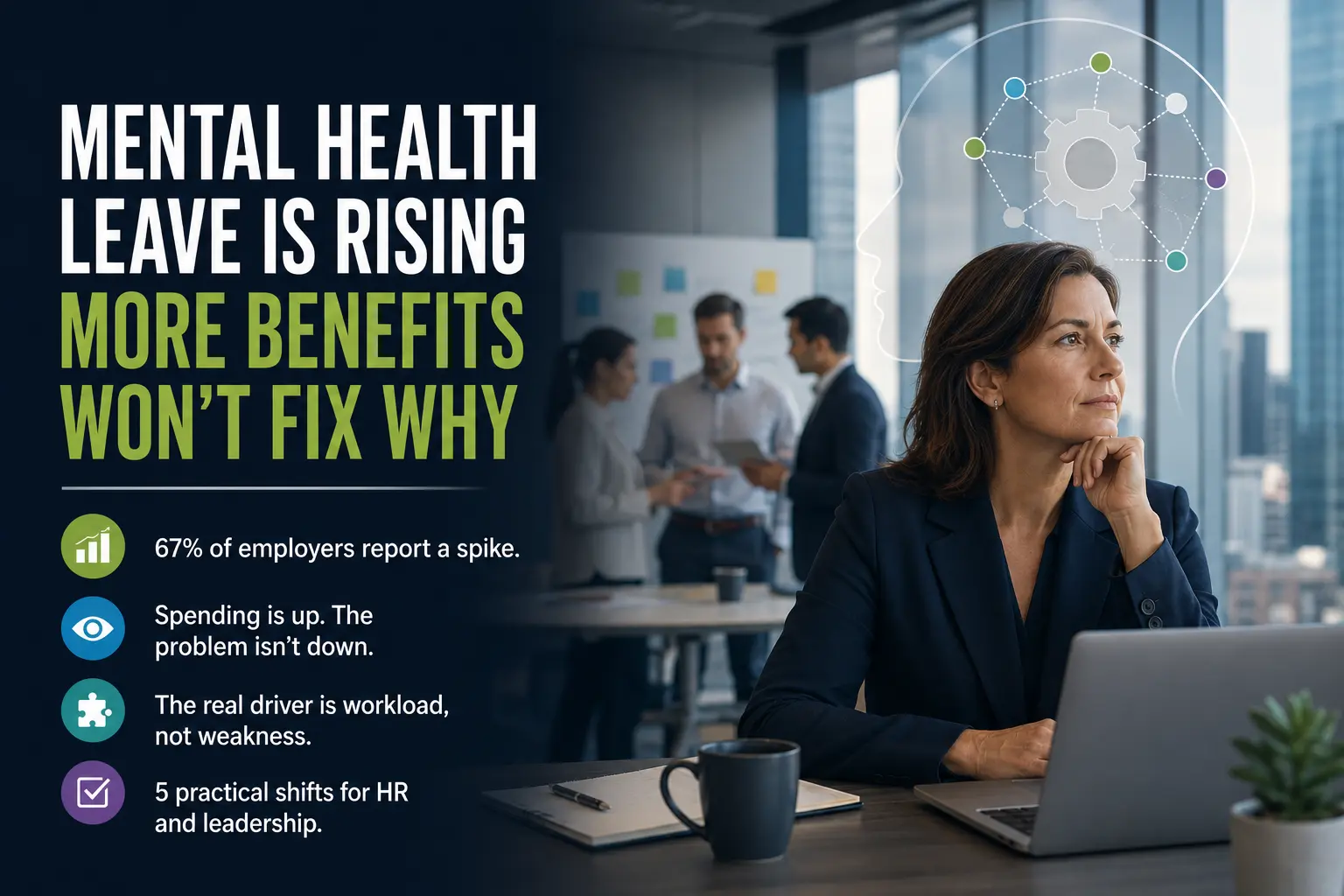
- 67% of US employers report an increase in mental-health-related leave and accommodation requests over the past year. Among large employers, that climbs to 74% (Littler Mendelson survey).
- At 1 in 6 organizations, the number of workers taking mental health leave jumped 25% or more in the last year (Spring Health survey).
- Missed workdays tied to mental health cost employers roughly $340 per day per full-time worker, adding up to $47.6 billion a year in lost productivity across the US (Gallup).
That’s not a rounding error on a budget line. It’s a cost employers are absorbing with leaner teams than they had a few years ago, and it’s showing no sign of levelling off. It’s also a coverage problem: unlike parental leave, mental health leave often arrives with little notice, and when it hits several people on the same team in the same stretch, there’s no backup plan built for it.
Workers are using the Family and Medical Leave Act (FMLA), which since 1993 has guaranteed up to 12 weeks of job-protected, unpaid leave for medical needs. Originally built around things like childbirth, it’s increasingly being used for anxiety, depression, and burnout, often with little warning to a manager. As one employment attorney put it in the piece, this looks like “a sustained shift, not a temporary disruption.”
The article traces the cause back to the pandemic itself. Employers expanded EAPs, added therapy benefits, and loosened stigma around asking for help, all good things on their own. But now, with hiring slower and teams leaner, the same absences that were manageable in 2021 are landing on thinner staffing and tighter budgets. Some companies are responding by expanding EAPs further (text-based therapy, on-site counseling), and a few, like talent agency CAA, have added new benefits like meditation apps and grief support to try to keep pace.
You can read the full piece on Bloomberg.com: More Workers Take Mental Health Leave, and Bosses Aren’t Happy
None of this leaves employers with easy choices. They still need to comply with leave obligations, support employees through genuine mental health challenges, and keep teams running. For many organisations, those pressures are colliding at the same time, making this both a people challenge and a business one.
The Part The Headline Numbers Miss
Here’s where it’s worth pausing. The instinct when a cost like this keeps rising is to spend more to contain it: another app, another counseling tier, another wellness perk. That’s the direction most employers are already moving in.
But nobody in the coverage, ours included until now, is asking whether that spend actually brings the cost back down. It’s an assumption, not a result. And if the leave numbers keep climbing while the benefits budget keeps growing, that assumption is worth challenging before signing off on more of it.
The more useful question underneath the cost line: why are so many people reaching the point of needing weeks off in the first place?
Adding an app doesn’t answer that. Neither does expanding an EAP. Those are conditions people can access after they’re already struggling. They don’t touch the thing generating the struggle: workload, role clarity, manager behavior, how much warning people get before change hits them.
This is the distinction between resilience theatre and actual prevention. A benefit that helps someone cope with an unsustainable job is not the same as fixing the job. If your mental health leave numbers keep climbing no matter how many wellness perks you add, they may be helping people recover, but they’re unlikely to be addressing the underlying drivers on their own.
What This Means For HR And Leadership
A few practical shifts worth making, based on where the pattern above tends to originate:
Look at where leave requests cluster, not just the total. Company-wide numbers hide the story. If leave requests are concentrated under specific managers or during specific project cycles, that’s a design problem with a location, not a generic “wellness” issue.
Don’t approve a new benefit without mapping the demand behind it. Before adding another app or counseling tier, ask what workload or role-clarity data is actually driving the requests. A benefit added without that answer is a bet, not a fix.
Train managers to catch overload before it becomes a leave request. Most of the workers in the Bloomberg piece described a slow build, therapy already in progress, dread before every check-in, before they finally stepped away. That’s a window leaders can be trained to notice and act on earlier.
Build a real channel for flagging overload, not just an open-door policy. Psychological safety isn’t a poster in the break room. It’s whether someone can say “this is too much” three weeks before it becomes a medical leave, and have that change something.
Separate the “are our benefits generous enough” conversation from the “is our system sustainable” conversation. They get treated as one conversation in most leadership meetings. They aren’t. The first is about coverage. The second is about design.
The Real Question
If your organization’s mental health leave requests keep rising no matter what you add to the benefits package, the question isn’t which benefit to add next. It’s whether anyone has looked at what’s actually generating the need for leave in the first place.
That’s a systems question, not a perks question. It’s also the one most companies haven’t asked yet.
This piece draws on reporting from Bloomberg Businessweek. If your leadership team wants help building the workload and psychosocial risk practices that reduce reliance on leave as the only release valve, that’s the work we do at WMHI.

