
Managing mental health at work has evolved from a peripheral concern to a central business imperative. Organizations today face mounting pressure to address psychological wellbeing not merely as a compliance issue, but as a strategic advantage that directly influences productivity, retention, and organizational culture. The WHO guidelines on mental health at work establish that workplaces bear significant responsibility for creating conditions that protect and promote mental health while preventing harm. This comprehensive guide provides evidence-based strategies for leaders, HR professionals, and managers committed to building psychologically safe environments.
Understanding the Business Case for Managing Mental Health at Work
Mental health conditions represent one of the leading causes of workplace disability worldwide. Current estimates indicate that depression and anxiety alone cost the global economy approximately $1 trillion annually in lost productivity. These figures underscore why managing mental health at work transcends ethical considerations to become a fundamental business requirement.
The relationship between workplace conditions and mental health operates bidirectionally. Poor work environments contribute to mental health deterioration, while untreated mental health conditions impair work performance. Organizations that implement comprehensive mental health strategies report measurable benefits across multiple domains:
- Reduced absenteeism through early intervention and supportive return-to-work programs
- Enhanced productivity when employees receive appropriate accommodations and support
- Improved retention as workers remain with employers who demonstrate genuine care
- Stronger employer brand that attracts top talent seeking psychologically safe workplaces
The Evidence Base for Workplace Mental Health Interventions
Research consistently demonstrates that workplace mental health interventions deliver positive returns on investment. The evidence-based recommendations from WHO highlight that organizational-level interventions addressing work design, management practices, and workplace culture produce more sustainable outcomes than individual-focused programs alone.
Effective interventions target multiple levels simultaneously. Individual support mechanisms matter, but structural changes addressing workload, autonomy, role clarity, and psychological safety create the foundation for lasting improvement.

Identifying Risk Factors and Protective Factors
Successful managing mental health at work initiatives begins with accurate assessment of workplace conditions. Risk factors fall into several categories that organizations must evaluate systematically.
Primary Workplace Risk Factors
| Risk Category | Specific Factors | Organizational Impact |
|---|---|---|
| Job Demands | Excessive workload, time pressure, conflicting demands | Burnout, anxiety, reduced performance |
| Control & Autonomy | Limited decision-making authority, rigid processes | Learned helplessness, disengagement |
| Support Systems | Inadequate manager support, poor peer relationships | Isolation, increased stress vulnerability |
| Role Clarity | Ambiguous responsibilities, conflicting expectations | Uncertainty, reduced effectiveness |
| Organizational Justice | Unfair treatment, lack of transparency | Cynicism, decreased trust |
| Change Management | Poorly communicated changes, job insecurity | Anxiety, resistance, turnover |
According to NICE guidelines on mental health at work, organizations should conduct regular psychosocial risk assessments to identify hazards before they precipitate mental health crises. These assessments require genuine employee input through confidential surveys and focus groups that capture authentic workplace experiences.
Building Protective Factors
Protective factors buffer employees against workplace stressors and promote resilience. Organizations can intentionally cultivate these conditions through deliberate policy and practice:
Psychological Safety: Environments where employees can speak up, ask questions, and admit mistakes without fear of punishment or humiliation form the cornerstone of mentally healthy workplaces. Leaders model vulnerability and respond constructively to feedback.
Social Connection: Strong workplace relationships provide emotional support and practical assistance during challenging periods. Organizations facilitate connection through collaborative work structures, team-building activities, and physical spaces that encourage interaction.
Meaningful Work: Employees who understand how their contributions align with organizational mission and societal value experience greater job satisfaction and resilience. Regular communication about impact and purpose strengthens this connection.
Growth Opportunities: Access to learning, development, and career progression signals organizational investment in employees and provides hopeful future orientation that protects against demoralization.
Developing Manager Capability for Mental Health Support
Managers serve as the primary interface between organizational policy and employee experience. Their capability in managing mental health at work determines whether well-intentioned programs translate into tangible employee benefit or remain abstract corporate rhetoric.
Core Competencies for Manager Mental Health Leadership
Effective mental health leadership requires specific, trainable competencies that extend beyond traditional management skills. The Leaders Masterclass addresses these critical capabilities through structured development programs.
Recognition and Early Intervention: Managers must develop observational skills to notice behavioral changes, performance shifts, or concerning patterns that may signal mental health challenges. This competency requires understanding baseline performance, maintaining regular meaningful contact, and creating conditions where employees feel comfortable disclosing difficulties.
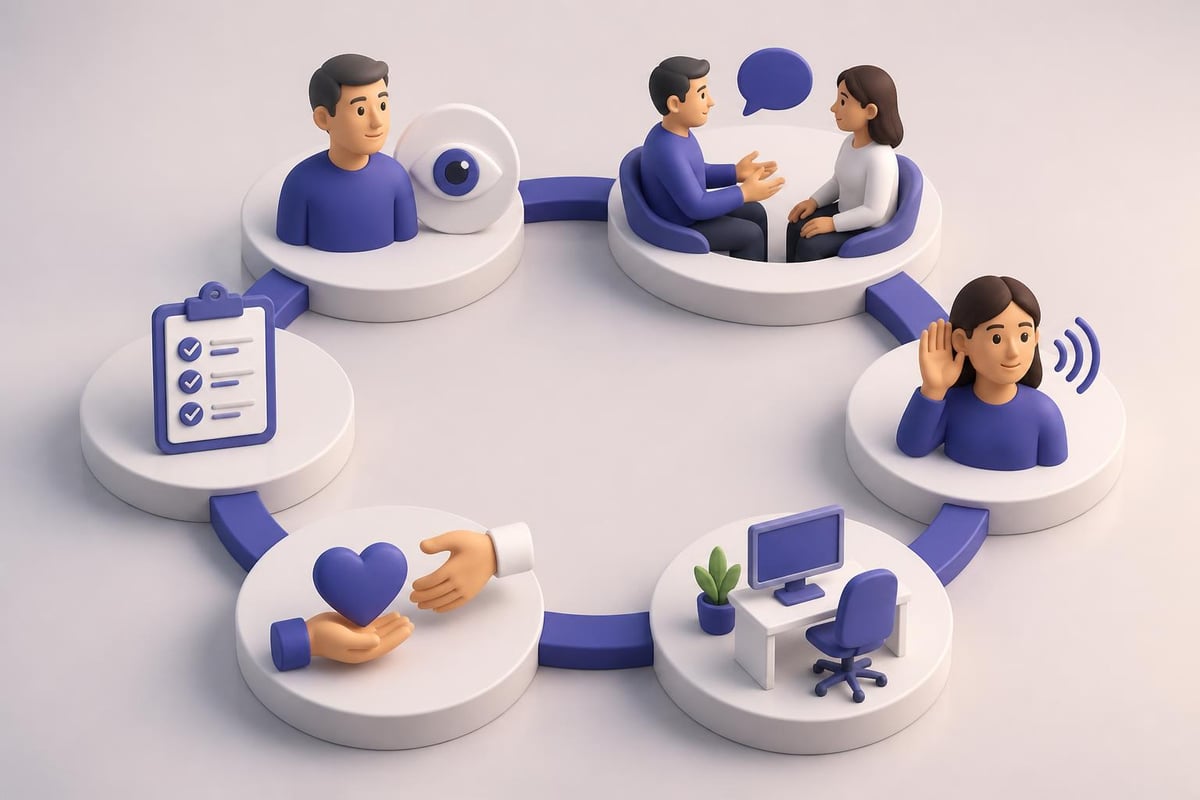
Psychologically Informed Conversations: Supportive conversations about mental health follow different protocols than performance discussions. The CDC provides guidance on initiating these conversations with empathy, active listening, and focus on practical support rather than diagnosis or treatment advice.
- Create private, uninterrupted space for sensitive discussions
- Express specific, observable concerns without judgment or assumption
- Listen actively with full attention and minimal interruption
- Ask open-ended questions that invite the employee to share their perspective
- Explore workplace adjustments that might provide practical support
- Connect to resources including EAP, HR support, or external services
- Follow up regularly to demonstrate ongoing care and monitor effectiveness
Avoiding Common Manager Pitfalls
Well-intentioned managers frequently make predictable errors when managing mental health at work. Training programs must address these specifically:
- Attempting to diagnose rather than focusing on observable behavior and workplace impact
- Offering personal advice instead of connecting employees to professional resources
- Breaching confidentiality by sharing information beyond those with legitimate need to know
- Delaying action due to discomfort or uncertainty about appropriate response
- Treating mental health differently from physical health in accommodation or support
Implementing Organizational-Level Mental Health Strategies
Individual support mechanisms remain insufficient without systemic organizational commitment to managing mental health at work. Comprehensive strategies address multiple organizational levels through coordinated action.
Policy and Procedure Development
Written policies establish organizational standards and employee rights regarding mental health. Effective policies address:
- Anti-stigma statements that explicitly welcome mental health discussions and prohibit discrimination
- Flexible work arrangements that accommodate mental health needs similarly to physical health conditions
- Leave provisions including mental health days and graduated return-to-work protocols
- Accommodation processes with clear procedures for requesting and implementing workplace adjustments
- Resource access detailing available support including EAP, counseling, peer support, and crisis services
Policies require regular review and updating to reflect evolving best practices and organizational learning. Employee consultation during policy development increases relevance and buy-in.
Work Design and Job Crafting
Fundamental work design choices profoundly influence mental health outcomes. Organizations serious about managing mental health at work examine and redesign work itself.
Workload Management: Systematic approaches to workload allocation prevent chronic overwork that depletes resilience. This includes realistic project timelines, adequate staffing levels, and protocols for redistributing work during high-demand periods.
Autonomy and Control: Employees with greater control over how they accomplish work experience less stress and greater job satisfaction. Organizations can expand autonomy through participative decision-making, flexible work methods, and trust-based management approaches.
Job Crafting Opportunities: Allowing employees to modify tasks, relationships, and perceptions of their work to better align with strengths and values increases engagement and psychological wellbeing. Structured job crafting programs provide frameworks for these beneficial modifications.
Creating Supportive Organizational Culture
Culture represents the informal norms, values, and behaviors that shape daily workplace experience. Managing mental health at work requires intentional culture development alongside formal policies and programs.
Leadership Modeling and Transparency
Senior leaders powerfully influence organizational culture through their visible behaviors and communication. Mental health-supportive cultures require leaders who:
- Share their own experiences with mental health challenges or work-life balance struggles appropriately
- Prioritize wellbeing in decision-making and resource allocation, not merely in rhetoric
- Use supportive language that normalizes mental health challenges and help-seeking
- Acknowledge organizational shortcomings and commit to continuous improvement
- Celebrate progress in creating psychologically safer environments
Stigma Reduction Initiatives
Stigma remains the primary barrier preventing employees from seeking support or disclosing mental health conditions. Systematic stigma reduction requires multi-pronged approaches:
| Strategy | Implementation Approach | Expected Outcome |
|---|---|---|
| Educational Campaigns | Regular communications, training sessions, resource sharing | Increased mental health literacy |
| Contact-Based Interventions | Sharing recovery stories, peer support programs | Humanized understanding of mental health conditions |
| Protest Activities | Challenging discriminatory language, correcting myths | Changed social norms around mental health |
| Structural Change | Policy reform, accommodation processes, inclusive practices | Reduced institutional discrimination |
Peer Support and Connection Programs
Formal peer support programs complement professional mental health services by providing accessible, relatable support from colleagues with lived experience. These programs require careful structure including peer supporter training, clear boundaries, supervision, and integration with professional services.
Measuring Effectiveness and Continuous Improvement
Evidence-based managing mental health at work demands rigorous evaluation to determine which interventions produce desired outcomes and where adjustments are necessary.
Key Performance Indicators
Comprehensive measurement frameworks track multiple indicators across different organizational levels:
Employee-Level Outcomes:
- Mental health symptom measures through validated screening tools
- Self-reported wellbeing and job satisfaction scores
- Help-seeking behavior and resource utilization rates
- Psychological safety perceptions
Organizational-Level Outcomes:
- Absenteeism rates and patterns
- Presenteeism estimates through productivity measures
- Turnover rates, particularly among high performers
- Workers compensation claims for psychological injury
- Return-to-work success rates following mental health leave
Cultural Indicators:
- Stigma assessment through attitude surveys
- Manager confidence in mental health support capabilities
- Employee awareness of available resources
- Participation rates in mental health programs

Learning Systems and Adaptation
Effective organizations treat mental health strategy as iterative rather than static. This requires establishing learning systems that:
- Collect data systematically through regular surveys, focus groups, and operational metrics
- Analyze patterns to identify what works, what doesn’t, and for whom
- Share findings transparently with stakeholders including employees
- Adjust interventions based on evidence rather than assumptions
- Document learnings to build institutional knowledge over time
The WHO policy brief on workplace mental health emphasizes that implementation requires flexibility to adapt evidence-based recommendations to specific organizational contexts, cultures, and resource constraints.
Special Considerations for Different Work Environments
Managing mental health at work takes different forms across varied work settings. Strategies require customization to address unique challenges in different contexts.
Remote and Hybrid Work Arrangements
Distributed work introduces specific mental health considerations. Isolation, blurred work-life boundaries, and reduced informal social connection require targeted interventions:
- Regular check-ins using video when possible to maintain human connection
- Clear communication protocols about availability and response expectations
- Virtual social opportunities that recreate informal workplace interaction
- Explicit right-to-disconnect policies that protect personal time
- Intentional inclusion of remote workers in decision-making and information sharing
High-Stress Occupations
Certain roles involve inherent psychological demands including exposure to trauma, life-and-death decisions, or chronic crisis response. Healthcare, emergency services, social work, and similar fields require enhanced support infrastructure:
- Trauma-informed organizational practices that recognize widespread trauma exposure
- Peer support programs delivered by colleagues with similar occupational experiences
- Regular psychological screening to identify emerging difficulties early
- Organizational acknowledgment of psychological hazards and commitment to mitigation
- Adequate staffing and breaks to prevent cumulative stress accumulation
Frontline and Customer-Facing Roles
Employees managing difficult customer interactions, handling complaints, or working in public-facing positions encounter unique stressors including emotional labor demands and occasional aggression. Supportive strategies include training in de-escalation techniques, backup protocols when situations become dangerous, and recognition of emotional labor as legitimate work deserving organizational support.
Integrating Mental Health with Broader Wellbeing Strategies
Managing mental health at work operates most effectively when integrated with comprehensive wellbeing approaches rather than treated as isolated initiative. Physical health, financial security, social connection, and purpose all interact with psychological wellbeing.
Holistic Wellbeing Frameworks
Leading organizations adopt integrated frameworks addressing multiple wellbeing dimensions:
- Physical wellbeing: Ergonomics, movement opportunities, healthy food access, preventive care
- Financial wellbeing: Fair compensation, financial education, emergency assistance programs
- Social wellbeing: Community building, inclusive culture, relationship support
- Purpose and meaning: Mission clarity, values alignment, contribution recognition
- Professional development: Growth opportunities, skill building, career progression
This integration recognizes that financial stress impairs mental health, physical pain affects psychological wellbeing, and social isolation increases vulnerability to mental health conditions. Addressing these interconnected dimensions produces synergistic benefits.
Alignment with Organizational Strategy
Mental health initiatives gain sustainability when aligned with core business strategy rather than positioned as peripheral corporate social responsibility. This alignment demonstrates through:
Performance Links: Connecting mental health to business outcomes including innovation, customer satisfaction, safety records, and quality metrics establishes relevance to organizational success.
Strategic Resource Allocation: Treating mental health as strategic investment deserving adequate budget, staffing, and leadership attention rather than optional expense to minimize.
Integration with Talent Management: Embedding mental health considerations throughout talent lifecycle from recruitment messaging through exit interviews ensures consistency and authenticity.
Resources such as those available through Workplace Mental Health Institute provide frameworks for this strategic integration, moving mental health from HR siloes into enterprise-wide priority.
Effective managing mental health at work requires sustained organizational commitment extending well beyond awareness campaigns into fundamental changes in work design, leadership capability, and cultural norms. Organizations that invest in comprehensive, evidence-based strategies build competitive advantage through enhanced employee wellbeing, reduced costs, and stronger performance. Workplace Mental Health Institute partners with organizations to develop customized mental health training and resilience programs that translate evidence into practical action, building manager capability and creating psychologically safe workplaces where all employees can thrive.

