A team’s workload becomes unmanageable after a major system rollout. Employees start skipping breaks, errors rise, two experienced people resign, and managers respond by reminding everyone about the employee assistance program. That is not psychosocial risk management. It is a late response to a problem the organization had the power to prevent.
Psychosocial risk management training gives leaders, managers, HR, and safety professionals the capability to identify how work is designed, led, and experienced – then act before pressure becomes harm, absence, turnover, or psychological injury. It moves the conversation beyond whether employees are resilient enough to cope. The better question is whether the work environment is sustainable enough for people to perform.
Why psychosocial risks require more than awareness
Psychosocial risks are features of work that can create harmful stress responses when they are severe, prolonged, poorly managed, or combined. They include excessive demands, low role clarity, limited control, conflict, bullying, poor change management, isolated work, job insecurity, exposure to trauma, and inadequate support.
These risks are not always dramatic. A high-performing employee may look productive while quietly compensating for unclear priorities, constant after-hours demands, or a manager who avoids difficult conversations. By the time the impact appears in absence data, grievance activity, disengagement, errors, or resignations, the risk has often been present for months.
Awareness campaigns can reduce stigma and encourage help-seeking. They have a place. But a poster, a wellbeing webinar, or an annual mental health day cannot fix a workload model that requires chronic overtime. Nor can it resolve an unsafe team dynamic or a change process that leaves people without information, control, or support.
The practical distinction matters: individual support helps people respond to distress; psychosocial risk management reduces avoidable sources of distress in the work itself. Effective organizations need both.
What psychosocial risk management training should build
Training should not turn managers into clinicians. They do not need to diagnose mental health conditions or carry responsibility for an employee’s treatment. They do need to recognize work-related risk indicators, hold constructive conversations, respond within their role, and escalate concerns appropriately.
For executives and senior leaders, the focus is governance. They need to understand where psychosocial risk sits alongside other operational risks, what data should be reviewed, how accountabilities are assigned, and whether major business decisions are creating preventable strain.
For HR, people and culture, and safety teams, training should build a common operating model. That includes risk assessment methods, consultation processes, reporting pathways, control design, incident response, and review cycles. Without shared language and clear ownership, psychosocial safety can become everyone’s priority in theory and nobody’s responsibility in practice.
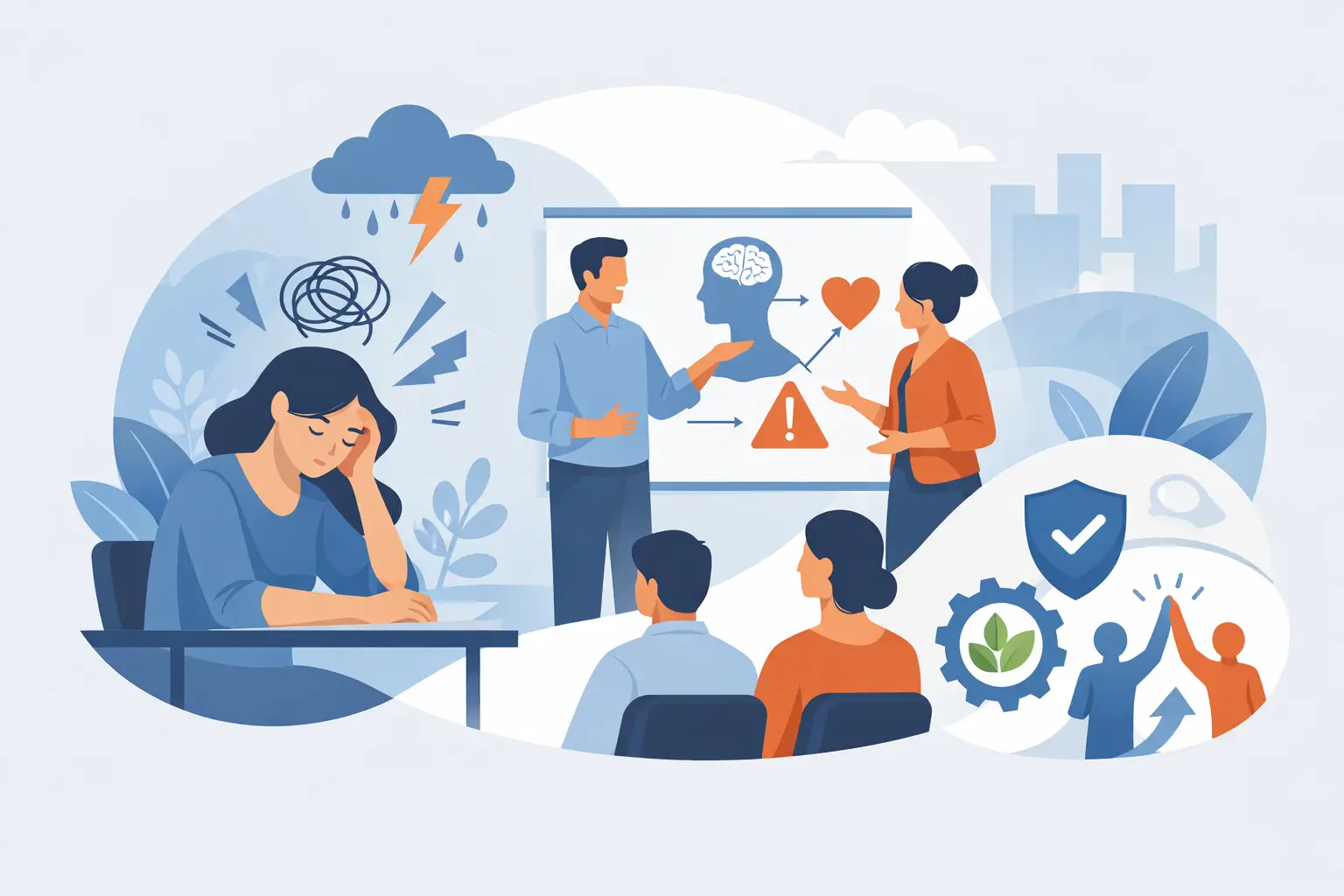
Frontline managers need the most practical capability. They should leave training able to clarify priorities, identify workload pressure, notice changes in behavior or performance without making assumptions, initiate a respectful conversation, address team friction early, and document or escalate concerns when needed. Their role is not to solve every problem alone. Their role is to lead work safely and connect employees to the right support.
The core skills to expect
High-quality psychosocial risk management training develops four connected capabilities.
First, participants learn to identify hazards in the work system, rather than relying only on whether someone discloses distress. Second, they learn to assess exposure by considering who is affected, how often the issue occurs, how severe the impact could be, and which groups may face heightened risk.
Third, they learn to select controls. The strongest controls usually change the source of the risk: redesigning workloads, clarifying decision rights, increasing staffing, improving job design, setting realistic deadlines, or strengthening leadership routines. Training should make clear that encouraging self-care is not a substitute for these actions.
Finally, participants learn to review whether controls are working. A policy that sits untouched in a shared drive is not a control. Organizations need evidence that work is becoming clearer, more manageable, more respectful, and safer to perform.
Start with the work, not the wellness calendar
The most useful training is grounded in real work scenarios. A call center team facing aggressive customer behavior needs a different risk response from a clinical team exposed to traumatic material, or a technology team working through repeated restructures. Generic content may create awareness, but it rarely equips people to make better decisions under pressure.
Before commissioning training, examine available organizational signals. Look at turnover patterns, overtime, leave use, absenteeism, workers’ compensation claims, safety incidents, employee feedback, grievances, exit interviews, engagement results, and operational error rates. No single metric proves a psychosocial problem. Together, these signals can show where attention is needed.
Then involve the people doing the work. Consultation is not a box-checking exercise. Employees and supervisors often understand the practical drivers of strain better than senior leaders do. They can explain where competing priorities collide, why a process creates unnecessary rework, or which changes have unintentionally removed support.
This approach also prevents a common mistake: treating a whole organization as if it has one risk profile. A business may have healthy executive teams and high risk in customer-facing operations. It may have strong peer support but weak role clarity during change. The controls should match the exposure.
Turning training into operational practice
Training creates capability. It does not, by itself, manage risk. Organizations need to build the learning into everyday systems and leadership expectations.
A manager who completes a workshop on workload conversations should have a regular forum to use those skills – for example, team planning meetings, one-on-ones, project reviews, and change briefings. If every meeting is dominated by delivery updates, risks will remain invisible until they become urgent.
Senior leaders should also make psychosocial risk visible in normal governance. When approving a major transformation, leaders should ask practical questions: What new demands will this create? Which roles have less control or support? Are timelines realistic? What consultation will occur? Who will monitor the effect on workload and team behavior?
There are trade-offs. Not every busy period is a psychosocial hazard, and no organization can eliminate pressure from work. Short-term intensity can be manageable when the purpose is clear, resources are adequate, recovery is possible, and leaders actively monitor the impact. Risk increases when high demands become business as usual, priorities remain unclear, or people fear consequences for speaking up.
Measure behavior, not attendance
Completion rates are useful, but they are not a meaningful outcome on their own. A 100 percent training completion rate can coexist with unclear workloads, poor manager behavior, and low trust.
Measure whether learning is changing practice. Are managers holding better workload and wellbeing conversations? Are teams raising concerns earlier? Are role expectations clearer during change? Are repeat hotspots reducing? Do employees report that they can speak up without negative consequences?
Qualitative feedback matters alongside data. A leader may report that a new workload review has improved decision-making, while employees may say it still feels unsafe to challenge deadlines. Both perspectives are needed to understand whether the control is working.
Choosing the right psychosocial risk management training
The right program depends on your organization’s risk profile, maturity, and workforce. A single introductory session may be appropriate for building shared language. It will not be enough for an organization managing high psychological injury rates, significant exposure to trauma, repeated conflict, or substantial operational change.
Look for training that is evidence-informed, facilitated by people who understand workplace realities, and tailored to different leadership levels. It should address prevention, early response, consultation, and escalation. It should also be clear about boundaries: workplace training supports safer work and capable leadership; it is not therapy or a replacement for clinical care.
Delivery format matters, too. Self-paced learning can scale foundational knowledge across dispersed workforces. Facilitated virtual or face-to-face sessions are often stronger for practicing conversations, applying risk controls to real scenarios, and building accountability across leaders. For complex risk environments, training should sit alongside assessment, policy review, leadership coaching, and implementation support.
WMHI approaches this work through a Mental Wealth lens: workforce mental health is not a peripheral benefit. It is an operating condition for sustainable performance, retention, safety, and trust.
The most credible signal an organization can send is not a wellbeing slogan. It is a consistent willingness to examine how work is designed, listen when people raise concerns, and equip leaders to act before strain becomes damage.