
Organizations face unprecedented challenges in 2026, from rapid technological transformation to evolving workforce expectations. The capacity of employees to navigate uncertainty, recover from setbacks, and maintain performance during adversity has become a critical determinant of organizational success. Resilience training in the workplace addresses this need by equipping individuals with practical skills to manage stress, adapt to change, and sustain wellbeing. This structured approach to building psychological resilience represents a strategic investment in human capital that yields measurable returns in productivity, retention, and overall workplace performance.
Understanding Workplace Resilience as an Organizational Capability
Resilience extends beyond simple stress management or positive thinking. It encompasses the ability to maintain equilibrium during challenges, recover from setbacks, and potentially emerge stronger from difficult experiences. In organizational contexts, resilience operates at individual, team, and systemic levels.
Individual resilience involves personal capacity to regulate emotions, maintain perspective, and deploy effective coping strategies. Employees with higher resilience demonstrate greater adaptability when facing role changes, technological disruptions, or increased workload demands. Research on resilience training effectiveness indicates that structured programs can significantly enhance this capacity across diverse organizational settings.
Team resilience reflects collective ability to navigate challenges while maintaining cohesion and performance. This dimension becomes particularly relevant during organizational restructuring, leadership transitions, or market disruptions that affect entire departments or units.
The Business Case for Structured Resilience Development
Organizations implementing resilience training in the workplace report multiple measurable benefits:
- Reduced absenteeism: Employees with developed resilience skills experience fewer stress-related absences
- Enhanced performance during change: Teams navigate transitions with less productivity loss
- Improved retention: Workers equipped with coping skills demonstrate higher job satisfaction
- Decreased healthcare costs: Organizations observe lower utilization of mental health crisis services
- Stronger safety culture: Resilient employees maintain focus and judgment during high-pressure situations
The return on investment becomes particularly evident when comparing intervention costs against avoided expenses from turnover, absenteeism, and reduced productivity. Organizations that integrate resilience development into broader wellbeing strategies position themselves to respond more effectively to both predictable stressors and unexpected challenges.

Core Components of Effective Resilience Programs
Successful resilience training in the workplace incorporates multiple evidence-informed elements rather than relying on single interventions. Programs designed with comprehensive frameworks address cognitive, emotional, behavioral, and social dimensions of resilience.
Cognitive Skills Development
Resilience training teaches employees to recognize and modify thought patterns that amplify stress or undermine coping. This involves:
- Identifying cognitive distortions such as catastrophizing, overgeneralization, or black-and-white thinking
- Developing realistic optimism through evidence-based assessment of challenges
- Building problem-solving capacity using structured approaches to workplace obstacles
- Enhancing perspective-taking to reduce personalization of organizational stressors
These cognitive skills provide employees with mental tools to evaluate situations more accurately and respond more effectively. Rather than promoting unrealistic positivity, quality programs emphasize balanced thinking that acknowledges challenges while identifying actionable solutions.
Emotional Regulation Techniques
The capacity to manage emotional responses during stressful situations directly influences both wellbeing and performance. Contemporary approaches to resilience training incorporate practical techniques for emotional regulation, including mindfulness-based practices, physiological regulation through breathing exercises, and strategies for processing difficult emotions constructively.
Emotional regulation training helps employees recognize early stress signals, interrupt escalating anxiety responses, and maintain composure during high-stakes situations. These skills prove particularly valuable for managers who must navigate their own stress while supporting team members facing challenges.
| Skill Category | Application Examples | Measurable Outcomes |
|---|---|---|
| Cognitive Reframing | Converting setbacks into learning opportunities | Reduced rumination, improved problem-solving |
| Stress Inoculation | Graduated exposure to manageable challenges | Enhanced confidence, lower anxiety |
| Relationship Building | Strengthening workplace support networks | Increased help-seeking, reduced isolation |
| Adaptive Coping | Matching strategies to controllable vs. uncontrollable stressors | More effective resource allocation |
Designing Resilience Training for Different Organizational Contexts
Effective programs align with organizational culture, industry demands, and workforce characteristics. A manufacturing environment facing safety pressures requires different resilience applications than a creative agency managing client expectations or a healthcare setting addressing trauma-informed care needs.
Tailoring Content to Organizational Stressors
Generic resilience programs often fail because they lack relevance to actual workplace challenges. High-performing organizations conduct thorough assessments before program design, identifying:
- Primary stressors: Which challenges most frequently compromise employee wellbeing and performance?
- Existing resources: What coping mechanisms and support systems already function effectively?
- Cultural factors: How does organizational culture influence stress responses and help-seeking?
- Performance contexts: Which roles face the highest resilience demands?
This assessment phase ensures training addresses real needs rather than theoretical concepts. For instance, customer-facing teams may prioritize emotional regulation during difficult interactions, while project managers might focus on maintaining perspective during scope changes and deadline pressures.
Delivery Formats and Learning Approaches
Resilience training in the workplace utilizes multiple delivery methods, each offering distinct advantages:
Workshop-based training provides immersive skill development with peer interaction and facilitator guidance. These intensive sessions work well for introducing core concepts and practicing techniques in supported environments.
Microlearning modules deliver focused content in digestible segments that accommodate busy schedules. This format supports ongoing skill development without requiring extended time away from work responsibilities.
Coaching and mentoring offers personalized application of resilience principles to individual circumstances. One-on-one support helps employees adapt general strategies to specific challenges they face.
Digital platforms enable self-paced learning with resources accessible when needed. Technology-enabled approaches can include interactive exercises, progress tracking, and just-in-time support during stressful situations.
Implementation Strategies That Drive Participation and Application
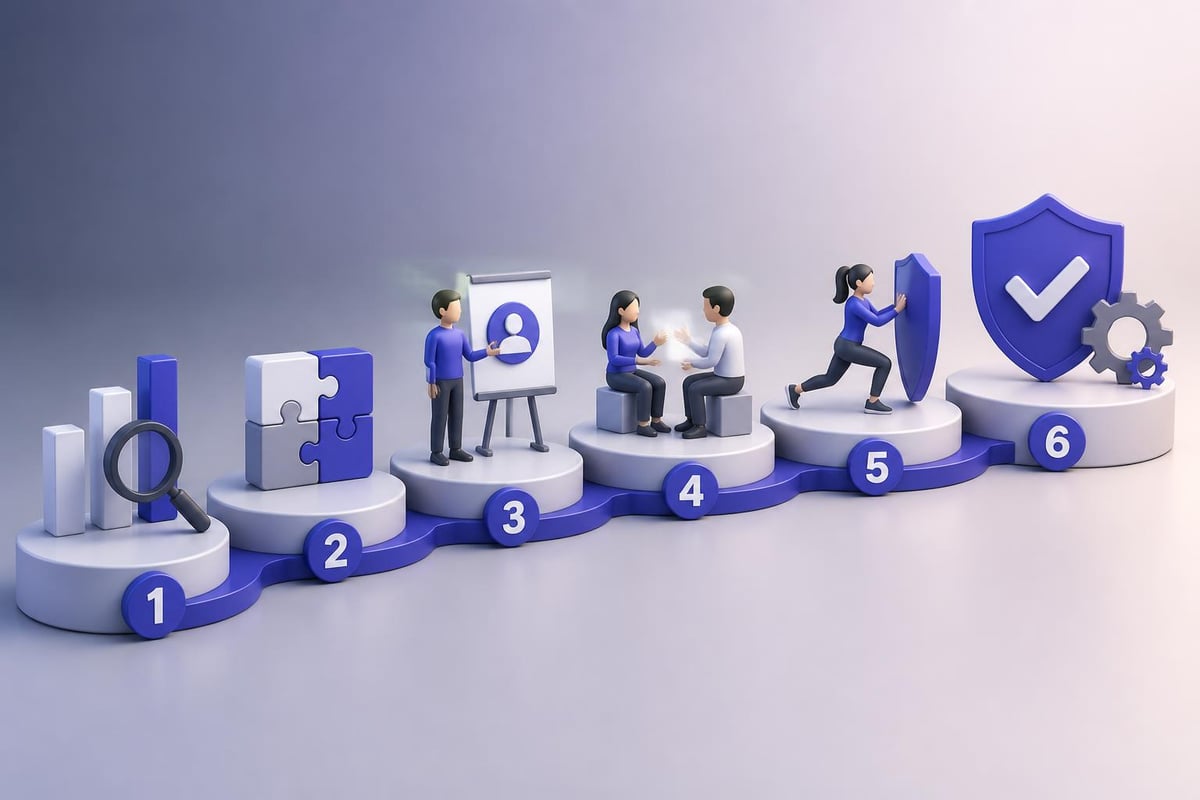
Even well-designed programs fail without effective implementation. Organizations achieving strong outcomes from resilience training in the workplace focus on integration rather than treating it as a standalone initiative.
Building Manager Capability as Program Foundation
Managers serve as critical intermediaries between organizational resilience initiatives and employee experience. Programs that prepare managers to model resilience skills, recognize employee stress signals, and provide appropriate support generate significantly better outcomes than those targeting only individual contributors.
Manager training should address:
- Recognizing early indicators of declining resilience in team members
- Conducting supportive conversations about stress and coping
- Modifying workload or expectations during high-pressure periods
- Connecting employees with appropriate resources
- Creating team environments that normalize resilience skill practice
When managers actively support resilience development, employees perceive programs as organizationally valued rather than optional add-ons. This leadership engagement proves essential for sustaining behavior change beyond initial training.
Creating Environmental Supports for Skill Application
Training alone rarely produces lasting change without environmental reinforcement. Organizations maximize training impact by modifying workplace systems to support resilience skill application:
- Adjust meeting structures to incorporate brief stress-reduction practices
- Redesign workload allocation processes to prevent sustained overload
- Establish peer support networks that normalize resilience conversations
- Integrate resilience metrics into wellbeing dashboards and reporting
- Recognize skill application through performance discussions and appreciation
These systemic changes signal organizational commitment while providing practical opportunities to practice new skills. Employees who see resilience principles reflected in workplace policies and practices demonstrate higher engagement with training content.
Measuring Resilience Training Effectiveness
Rigorous evaluation distinguishes effective programs from those producing minimal impact. Organizations implementing resilience training should establish measurement frameworks before program launch, identifying both leading indicators of skill development and lagging indicators of organizational outcomes.
Assessment Approaches and Metrics
Pre- and post-training assessments measure individual resilience capacity changes using validated instruments. These psychological measures capture shifts in coping skills, stress appraisal, and emotional regulation ability.
Behavioral observations track actual application of resilience techniques in workplace situations. Managers can note instances when employees demonstrate learned skills during challenging circumstances.
Organizational metrics reveal program impact on business outcomes:
| Metric Category | Specific Measures | Data Sources |
|---|---|---|
| Wellbeing | Stress levels, burnout indicators, satisfaction scores | Employee surveys, pulse checks |
| Performance | Productivity metrics, quality indicators, project completion | Operations data, performance management systems |
| Retention | Voluntary turnover rates, retention of high performers | HR information systems |
| Healthcare | Mental health claims, employee assistance program utilization | Benefits administration data |
Qualitative feedback provides context for quantitative findings. Focus groups and structured interviews reveal how employees apply skills, which components prove most valuable, and what barriers limit application.
Continuous Improvement Based on Evidence
High-performing organizations treat resilience programs as evolving initiatives rather than fixed interventions. Regular review of evaluation data identifies opportunities for refinement:
- Which program elements generate strongest engagement and application?
- Do certain employee populations benefit more than others?
- What workplace barriers prevent skill application?
- How do program outcomes compare to initial objectives?
This evidence-informed iteration ensures programs remain relevant as organizational contexts and workforce needs change. Research on stress management and resilience training demonstrates that programs incorporating regular refinement based on participant feedback and outcome data achieve superior long-term results.

Integrating Resilience Within Comprehensive Mental Health Strategies
Resilience training in the workplace functions most effectively as one component within broader mental health frameworks. Organizations achieving strongest outcomes recognize that resilience development complements rather than replaces other essential mental health supports.
Positioning Resilience Alongside Intervention and Treatment
Resilience training operates primarily at prevention and early intervention levels. It equips employees with skills to manage routine workplace stress and navigate moderate challenges. However, resilience training alone cannot address clinical mental health conditions requiring professional treatment.
Comprehensive strategies incorporate multiple support tiers:
- Prevention: Resilience training, stress management education, wellbeing resources
- Early intervention: Manager conversations, peer support, self-help tools
- Treatment: Employee assistance programs, mental health benefits, return-to-work support
- Crisis response: Immediate support protocols, trauma response, safety planning
Organizations should clearly communicate that resilience training enhances coping capacity while recognizing that some situations require clinical intervention. This clarity prevents stigma associated with seeking help when resilience strategies prove insufficient for addressing serious mental health challenges.
Connecting Resilience to Organizational Culture
Sustainable resilience emerges from organizational cultures that value wellbeing, normalize challenge discussion, and support adaptive responses to stress. Training initiatives produce limited impact when delivered into environments characterized by chronic overload, poor psychological safety, or leadership behaviors that contradict resilience principles.
Cultural elements supporting resilience development include:
Psychological safety that allows employees to acknowledge difficulties without fear of judgment or career consequences. Teams with high psychological safety demonstrate greater willingness to experiment with new coping strategies and seek support when needed.
Realistic workload management that prevents sustained overload requiring constant resilience deployment. Organizations should view resilience skills as resources for navigating periodic challenges rather than compensating for systemic dysfunction.
Leadership modeling where senior leaders demonstrate resilience skills, discuss their own coping strategies, and prioritize wellbeing alongside performance. Visible leadership commitment legitimizes resilience as organizationally valued.
Recovery opportunities including adequate rest breaks, vacation utilization, and boundaries around after-hours communication. Resilience requires periods of recovery; cultures demanding constant availability undermine resilience development regardless of training quality.
Advanced Considerations for Program Sustainability
Organizations maintaining effective resilience programs beyond initial implementation focus on several sustainability factors that distinguish temporary initiatives from lasting organizational capabilities.
Building Internal Capability
Dependence on external providers creates sustainability challenges as budgets fluctuate or priorities shift. Developing internal expertise in resilience training through train-the-trainer approaches enables ongoing program delivery without recurring external costs.
Internal facilitators offer advantages beyond cost efficiency. They possess deep organizational knowledge, understand cultural nuances, and provide continuity as programs evolve. Organizations building internal capacity should ensure facilitators receive:
- Comprehensive training in resilience theory and evidence-based practices
- Facilitation skill development for engaging diverse employee groups
- Ongoing supervision or consultation to maintain quality
- Regular updates on emerging research and practice innovations
Addressing Diverse Workforce Needs
Workforce diversity requires resilience programs that acknowledge varied experiences, stressors, and cultural contexts. Generic programs may inadvertently disadvantage employees whose circumstances differ from assumed norms.
Inclusive resilience training considers:
- Cultural variations in stress expression, coping preferences, and help-seeking patterns
- Role differences in stressors faced by frontline workers versus knowledge workers
- Generational factors influencing technology preferences and learning styles
- Accessibility requirements ensuring full participation regardless of disability status
- Language considerations for multilingual workforces
Programs incorporating diverse examples, offering multiple participation formats, and inviting employee input on content relevance demonstrate greater engagement across varied employee populations.
Maintaining Momentum Through Reinforcement
Initial training generates enthusiasm that fades without systematic reinforcement. Successful organizations implement multiple touchpoints that keep resilience principles visible and provide ongoing skill development opportunities:
- Monthly micro-learning delivers focused content on specific resilience skills
- Manager check-ins include resilience discussions in regular one-on-ones
- Team retrospectives incorporate resilience reflections after challenging projects
- Refresher sessions revisit core concepts and introduce advanced applications
- Resource libraries provide on-demand access to exercises and tools
This sustained engagement prevents resilience from becoming a one-time training event that employees forget amid competing priorities. Regular reinforcement signals ongoing organizational commitment while supporting continuous skill development.
Resilience training in the workplace represents a strategic approach to building organizational capacity for navigating an increasingly complex business environment. When designed with evidence-informed practices, tailored to organizational contexts, and integrated within comprehensive mental health strategies, these programs deliver measurable improvements in employee wellbeing and organizational performance. Workplace Mental Health Institute specializes in developing customized resilience programs that combine psychological rigor with practical application, supporting organizations in building sustainable cultures of wellbeing and performance.

